
Sherlock, Jr. (1924)
Buster Keaton directs and stars in this under an hour comedy as the young, extremely agile, film projectionist. The sight gags are some of the best (and most copied) in cinema.

Sunrise (1927)
Moving story of a couple's romance, the camera transports the viewer through film, photo and painting in a hallucinatory, but beautiful, reverie.

The Last Command (1928)
The tragedy only deepens since it's cast as a farce: a general of the Russian army banished after the Revolution finds himself playing himself in a movie in Hollywood.

The Passion of Joan of Arc (1928)
Falconetti's brilliant portrayal of Joan and the visually stunning shots and close-ups make for one of the most beautiful and moving films ever made.

A Man with a Movie Camera (1929)
Incredible cinematography documenting modern Soviet Russia, no other film has such a unique and powerful structure, rewriting the language of how to view film.

M (1931)
Fritz Lang's psychological thriller was initially a docudrama of current events, which has subsequently become an allegory of public and private madness.

Grand Hotel (1932)
This is as close to Chekhov as I can get: A series of character portraits performed but some of the best actors of the day as they cross paths in the Grand Hotel: Garbo, Beery, two Barrymores, and Crawford.

Duck Soup (1933)
The best of the Marx's films, splendidly blending slapstick and witty dialogue, most of Groucho's quotes come from this one.

King Kong (1933)
The fun thriller that still is a good watch, even if the graphics aren't fantastic, Kong entertains in the classic scenes.

Camille (1936)
Greta Garbo's best performance as a social climber who is torn between the lap of luxury and true love, each scene is gripping as the plot develops.

Dodsworth (1936)
The finely mature story of a husband and wife's respective, and very different, midlife crises.

Modern Times (1936)
Chaplin's best performance blends humor with social satire (the first images are of sheep juxtaposed by people leaving a subway) in a light-hearted romance.

Grand Illusion (1937)
Renoir tells the story of a group of officers who escape from prisoner of war camps during the Second World War. Throughout the humanity, and sagacity, of both sides muse on deeper themes.

Olympia (1938)
One of the most stunning documentaries ever made by Leni Reifenstahl brilliantly portraying the human physique.

Ninotchka (1939)
Splendidly humorous story focuses on Garbo's cold Soviet exterior melting in Paris, surrounded by amusing characters in outstanding situations.

The Wizard of Oz (1939)
Flying monkeys, a cowardly lion and great songs add to an engaging plot of Dorothy's quest to find the Wonderful Wizard.

Fantasia (1940)
One of Disney's best cinematic pieces, brilliant animation of mushrooms, dinosaurs, and a Night on Bald Mountain accompany the classical music.

His Girl Friday (1940)
Cary Grant and Rosalind Russell compliment each other in one of the funniest and best written romantic comedies ever about reporters fighting for a story.

Citizen Kane (1941)
Watch this for Orson Welles' performance. The story is intriguing enough, and the cinematography is, on average, good. But Welles' acting makes viewing worthwhile.

Casablanca (1942)
If you've not heard of this film, or quote it, then you must've been living under a rock.

Children of Paradise (1945)
Brilliant acting about a troupe of actors in France in the 1830's who are trying for love, fame, or to just get by.

Notorious (1946)
The Grant-Bergman romance is passionate yet bitter amidst the undercover spy suspense in Rio.

The Third Man (1949)
Film Noir peak with supreme acting by Orson Welles as the mysterious Harry Lime.

White Heat (1949)
Cagney's brutal character will keep you on the edge of your seat as his tragic story relentlessly plays out.

An American in Paris (1951)
Gene Kelley takes the title role in a romantic musical comedy featuring great dance sequences, Gershiwn's score, and Oscar Levant's masterful piano pieces.

Ikiru (1952)
Kurosawa's story of an elderly bureaucrat who looks back and realizes his life has been of no consequence, leading to redemption; the counter 'It's a Wonderful Life'.

Umberto D. (1952)
The entire cast is comprised of non-professional actors, a fact no one could figure out on their own. The moving story of an aging pensioner's struggle accompanied by his dog.

Ugetsu (1953)
The story of two couples, neighbors, and their various fortunes in war: all four take different paths in the chaos and have their own trials to overcome.

Seven Samurai (1954)
Kurosawa's epic of the seven samurai without a leader who must protect a farming village from gangs.

The Apu Trilogy (1955, 56, 59)
Satyajit Ray's magnificent three-part film tells the story of a child, an adolescent, and a young man's hardships and triumphs.

Smiles of a Summer Night (1955)
Bergman claimed he had two options that summer: "Write Smiles of a Summer Night or kill myself." Luckily he chose the path of endearing romantic comedy.

Invasion of the Body Snatchers (1956)
It's hard to see this sci-fi horror as more than just a glorified 'B' movie or allegory of rampant McCarthyism. But it succeeds in terrifying the viewer with an original, frightening depiction of humanity.

12 Angry Men (1957)
Suspenseful film shot in a jury room where twelve men have to decide if a kid lives or dies.

Bridge on the River Kwai (1957)
Alec Guiness' best role as the British Officer holding on to his principles in a Japanese POW camp that is trying to break his spirit.

Sweet Smell of Success (1957)
Great drama doesn't require over the top scenarios: Tony Curtis is a small-time press agent up against the giant of his world: a columnist who refuses to make him.

Vertigo (1958)
Jimmy Stewart's great performance as the retired detective who investigates the split personality and past of a beautiful woman with whom he falls in love.

The 400 Blows (1959)
The story of a youth growing up and his progression from a kid who cuts up in class to being taken into state custody as a 'delinquent'.

Hiroshima Mon Amour (1959)
Identities, place and memory are all up for grabs in this landmark film about unlikely romance at the epicenter of the post-modern world.

La Dolce Vita (1960)
Marcello Mastroianni (playing Marcello) would later collaborate with Fellini in his portray of Fellini in 8 ½. In this Marcello is far more human, bemusedly observing the reckless behavior of the rich and famous.

Psycho (1960)
The ultimate mystery suspense thriller captures one of the most terrifying personalities ever created in brutal black and white shots.

Yojimbo (1961)
Kurosawa delivers a one man tour d' force satire western: the plot is standard (one man cleans up a corrupt town) but the performance, humor, and stark visuals are way beyond par for the course.

Jules and Jim (1962)
Perhaps the best love triangle portrayed in film. Or the best story of two men's friendship. Or the story of France and Germany's love-hate affair. You decide.

Lawrence of Arabia (1962)
Peter O' Toole stars as T.S. Lawrence who attempted to single-handedly unite the Arab world, surrounded by great co-stars and sweeping cinematography.

The Manchurian Candidate (1962)
Angela Lansbury shines as the villainous over-bearing mother who wants to put a sleeper in the White House, leaving Sinatra to stop her son from an assassination.

To Kill a Mockingbird (1962)
Growing up in the South, Scout looks to her father Atticus, played superbly by Gregory Peck, as a moral compass surrounded by inequality.

8 1/2 (1963)
The ultimate movie about making a movie, a director loses his inspiration and struggles to come up with the means to express himself.

Dr. Strangelove or: How I Learned to Stop Worrying and Love the Bomb (1964)
Sellers plays three roles in Kubrick's black comedy: a British officer, President of the United States, and his advisor, the eponymous Strangelove, as the world may be ending.

A Hard Day's Night (1964)
It's been a while since a movie has really captured my spirit, but the partial documentary, starring the Fab Four, is not just fun, it's cinematographically mesmerizing.

Battle for Algiers (1966)
The extreme grittiness of this film is found in the deception of cinematography making you forget it's a drama and not a documentary of the uprising in Algeria against the French colonials.

The Good, The Bad, and The Ugly (1966)
The story of treasure lures you in with the three outlaws, against the background of the Civil War. The cinematography and production would be beat only by Leone's own efforts two years later.

Persona (1966)
An actress' lack of speech finds her being cared for by a young nurse. Their cottage retreat turns from an isolated holiday to a painful co-dependence and jealousy of each other's afflictions.

Mouchette (1967)
The bleak tale of what may be the most wretched little girl in cinema history; the stark pain is elevated by the realization that she has lost all capacity for emotion.

2001: A Space Odyssey (1968)
Beyond the apes and Technicolor swirlings is the bulk of the film: an astronaut's race to beat an evil supercomputer, the HAL 9000, from destroying his ship and himself.

Once Upon a Time in the West (1968)
Sergio Leone's cinematography can be beat only by the score and Henry Fonda's role as 'Frank' in this Western epic of how the West was really won.

Fiddler on the Roof (1971)
Topol plays Tevye raising his daughters Jewish in pre-Revolution Russia, doling out wisdom and fantastic musical numbers.

A Touch of Zen (1971)
The greatest of Kung Fu masterpieces, not for it's amazing fights (the inspiration for Crouching Tiger, Hidden Dragon) but for it's engrossing plot, acting, and cinematography.

The Discreet Charm of the Bourgeoisie (1972)
A surrealist look at the French bourgeoisie where it is unclear if what is portrayed is dream, reality, production or something else. The cast just goes along with it, whatever it is.

The Godfather Parts I+II (1972, 74)
The second half is superior to the first. The two combined creates a story told in three compelling narratives, portrayed by top actors of the rise, and fall, of America's most powerful family.

Solaris (1972)
Suspenseful and art house don't often go together well, but in this science fiction tale the creeps don't come from an evil spaceship, aliens, or HAL. Instead the uneasiness is provided by ourselves in a reflection on conscience.

Day for Night (1973)
Capturing the process of making a film the cast, crew, and director (who is played by the director Truffaut himself) exemplify the hysteria, pleasure and drama of a movie set.

Blazing Saddles (1974)
Wilder and Cleavon Little co-star with Madeline Khan in the farcical depiction of life in the West, at least as it appears on the back lots.

Chinatown (1974)
Jack Nicholson is trying to unravel a few mysteries at once, while keeping his nose out of trouble investigating conspiracy and murder.

Barry Lyndon (1975)
Lyndon's tragic arc plays out slowly, yet you can't imagine telling the story at a different pace. The shots are truly picturesque: freeze-frame and you could hang them on your wall.

Monty Python and the Holy Grail (1975)
For Arthur and his K-nig-its to find the Holy Grail leads to obstacles such as the Knights who say 'Ni!', murderous bunnies, and silly Frenchmen.

The Rocky Horror Picture Show (1975)
Transsexual transvestite aliens, lead by Tim Curry, abduct and corrupt the youths Brad and Janet, singing catchy tunes while doing so.

Network (1976)
The big screen takes on the small screen.

Taxi Driver (1976)
Gritty realism? Maybe. Yet shot after shot confirms Scorsese's talent with the camera and scene after scene De Niro's psychotic persona captivates.

Star Wars IV: A New Hope (1977)
Luke, Han, and Leah join the Rebellion under the guidance of Obi-Wan and assistance of wookies and droids to fight the Empire, and it's masked face: Darth Vader.

Apocalypse Now (1979)
A man is sent up river in Cambodia to find Col. Kurtz, Marlon Brando, who has gone AWOL during the height of Vietnam; the further up river the more primitive the world becomes.

Mon Oncle D'Amerique (1980)
Is it a documentary on behaviorist psychology? A drama of three individuals mid-life crises? The answer is, pleasantly, both.

Blade Runner (1982)
Harrison Ford is specially trained to track down replicas that have gone astray in the future, and has to find four particularly difficult cases and battle with his own conscience.

The Dark Crystal (1982)
Henson's high-fantasy story traces the characters of Jen and Kira, gelflings who have to overcome the vulturous Skeksis despotic rule of their planet.

Koyaanisqatsi (1982)
With no conventional plot, or documentary theme, 'koyaanisqatsi' translates from Hopi as 'life out of balance', as exposed by the images and music.

Twice Upon a Time (1983)
Visually stunning animation not for kiddies tells the story of Ralph and Mumford trying to be heroes and save us from the nightmares concocted by vile 'Synonamess Botch.'

Brazil (1985)
Gilliam's masterful story of a man in the future, played by Jonathan Price, who needs to unravel a mystery and discovers the unpleasant underbelly of his society.

The Purple Rose of Cairo (1985)
A nervous, desperate woman, who finds her escape in movies during the depression, is jolted into a real on and off-screen romance.

The Princess Bride (1987)
True love between Buttercup and Westley must overcome a pirate, a Spaniard, a giant, and a Sicilian, all before entering the Fire Swamp, joking along the way.

Wings of Desire (1987)
The story of an angel who feels the need to see more than the colorless, weightless spiritual world in which he cannot intervene, who breaks through to humanity.

A Fish Called Wanda (1988)
Kevin Kline is the brilliant gem surrounded by Cleese, Palin, and Curtis in a romantic comedy caper that's not safe for fish or small dogs.

Cinema Paradiso (1988)
A master-work of nostalgia and embodied memory as viewed by the movie projectionist and the movie director.

Goodfellas (1990)
The brilliant trifecta of Mafiosos (De Niro, Pesci and Liotta) execute Scorsese's peculiar wish to blend a mob movie with a "rollicking road picture".
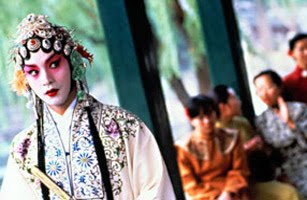
Farewell My Concubine (1993)
The story of two stage brothers, king and concubine, whose lives are a reflection of the opera they perform and the turbulent times they live through.

Groundhog Day (1993)
Bill Murray is the cynical newsman who finds himself reliving the same day of his life over and over, especially comedic are his attempts to off himself before redemption.

Jurassic Park (1993)
Sam Neil and crew are trapped on an island where dinosaurs have been brought back to life, when things start to go suspensfully wrong.

The Nightmare Before Christmas (1993)
Claymation never looked so good: Skellington lives in Halloweentown, where the repetition bores him, leading to the desire to become St. Nick.

Chungking Express (1994)
Chinese 90's romance never looked so good: Parallel stories revolve around lovesick cops and fast food, in an atmosphere of Hong Kong noir.

Clerks (1994)
Two clerks bitch about their jobs and lives, with minor escapades and great comic dialogue during a hard day at the store.

Pulp Fiction (1994)
Three interwoven stories: A hit man taking the boss' wife for a night of fun, a boxer trying to avoid the boss, and the hit man and his accomplice needing some assistance with body removal.

The Shawshank Redemption (1994)
Tim Robbins and Morgan Freeman find themselves prisonmates in Shawshank, where they bond and lift each other up and out into hope.

Ulysses' Gaze (1995)
A man's journey to find the first film leads him to retrace his own childhood steps in the war-torn Balkans.

The Fifth Element (1997)
In the future the aliens responsible for the Pyramids revisit Earth attempting to contain the balance of Good and Evil, but things go wrong and Bruce Willis needs to save humanity.

The Big Lebowski (1998)
The Dude doesn't want to do much but drink White Russians, listen to Creedance and go bowling with his buddies. But he gets mixed-up in a kidnapping caper.

The Truman Show (1998)
Truman lives a normal life, but soon it starts to unravel. His quest to come to grips with what is reality would ironically precursor the 'reality television' movement of the next decade.

Snatch (2000)
Guy Ritchie infuses comedy into a gangster film full of boxing, guns, dogs, pikeys, and a diamond the size of your fist.

City of God (2002)
The slums of Rio provide a horrific breeding ground for gang warfare where the gangsters running the streets are mere children.

Talk to Her (2002)
Subtle and enchanting it's only after viewing that you realize how brilliant the modern love story is, from the cinematography to messages it cares to share.

Triplets of Bellville (2003)
Near-silent French animation tells the story of a grandmother and her boy whose dream is to ride the Tour D' France; his kidnap leads her to recruiting the odd triplets in her rescue mission.

Zatoichi (2003)
The story of the blind samurai Zatoichi, played by Takeshi Kitano, who joins unusual companions in ridding a town from rival gangs.

The Incredibles (2004)
In the Pixar debate 'Incredibles' will likely be seen as the victor: The story is well-animated, funny and exciting, moved by the engaging characters.

Mirrormask (2005)
Incredible visuals bring to life Gaiman's novel, with bright, funny characters in a fantastic story about the girl who grows up in the circus and wants to escape to the normal world.
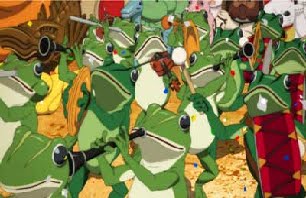
Paprika (2006)
Satoshi Kon blends together his own visions, developing since Perfect Blue, with major themes tackled by anime since Akira on the role of science and technology, reality and dreaming, individuality and avatar.

