Tuesday, April 14, 2015

Two-Week Road Trip

We went on a long journey my sister, my mom, and I. Here is the transcript, in rough form, of that journey, noting that the photos are not my own:

Day One

Drove down from Boston to Shenandoah Park. Much of the trip was spent playing cars games, collecting state license plates, etc. Drove across the Washington Bridge to get past NYC. Got food on the road for lunch and dinner. Got down to Virginia late – winding night road into the Park, snowy all along Skyline Drive, eventually getting to Skyland. Very cold on arrival – gloves needed to take luggage to the cabin. The cabin was probably from the 50s, done in knotty pine, with a balcony to look onto the valley below.

Shenandoah

Day Two

In the morning we drove to the dining room of Skyland – named for our ancestor George Pollock – and got a hearty breakfast to start, unfortunately seated by the large, beautiful, and cold, picture windows. Drove along Skyline Drive for a bit, taking pictures at pull-outs and did a quick little jaunt (500 ft or so) along the Appalachian Trail at one of the overlooks. Exited the Park off Skyline around noon and began driving through backroad Virginia. Along the way, after a few hours, we stopped at Natural Bridge – a National Historic Landmark. It was once owned by Thomas Jefferson, and is still privately owned by Bible-thumpers. There were icicles, so we couldn’t walk directly under it, and the river still flows through the valley. We were glad of this, as we watched the giant icicles fall into the river below. A short stop became a long stop, and we again got on the road headed for Tennessee. Got dinner on the way at an unusual place with ginormous portions, apple muffins, and mediocre quality. After nightfall we drove through Pigeon Forge which is a hideous amalgamation of neon and tacky – a worse version of Vegas for the South. We figured out this is where Dollywood was, which explained some of it. We were staying at a Motel 6 in Gatlinburg, right near the entrance of the Great Smokey Mountains National Park World Heritage site.

Natural Bridge

Pigeon Forge at night

Day Three

We got up and wandered down to Gatlinburg’s main strip where we found an odd English Tudor-esque area and a small bakery ‘The Donut Friar’, getting a half-dozen donuts for us each to have two. We then drove into the Park, stopping frequently at overlooks for pictures. Spring was just beginning to have sprung. The area is still largely old growth, which is unique for East of the Mississippi. Near the river we took a small guided hike of about .75 of a mile, and learned more in depth about the ecosystems such as pervious inhabitants, and endemic species (more in that forest than all of Western Europe). We drove on, after a short, muddy, hike of maybe .25 of a mile. We got to Cherokee, North Carolina, and stopped for gas. When we tried to turn on the car it wouldn’t start. The battery worked, and concerned Carolinians tried to help, but to no avail – we called AAA. An hour later a fellow with a flatbed drove us back to Tennessee – we had to go around the long way because the road through the Park doesn’t allow commercial vehicles. This took more than two hours, and we learned our driver was Charlie McCoy – descended of the WV feud. Apparently his first wife was even a Hatfield. After dropping of the car in Sevierville (pronounced ‘severe-vuhl’) he dropped us off back at our Motel in Gatlinburg – a thoroughly nice fellow. Ordered pizza late at night, delivered to the room.

Great Smokey Mountains

Day Four

Got up and got a “taxi” to the Sevierville mechanic. In the car’s front seat was the driver, something of a good ol’ boy, in his front seat a friend, and in the trunk a girlfriend.  We got the car back – it had needed a new starter – and hit the road towards Kentucky around noon-ish. In Knoxville we stopped at the Market Square – a pretty plaza in the heart of downtown, where we got lunch at Tomato Head – a restaurant admired by the local foodies for local ingredients, organic everything, and vegan options. It lived up to its reputation, by and large. We drove on into Kentucky, and shortly outside of Cave City, got a flat on the back right tire. One young man tried to help us, but the lugnuts were on too tight. AAA was called again – a tow truck was found with a flatbed that took us to the next town up, and again dropped off the car. This time the tow truck only had room for two. A friend of the driver was called, and an older fellow picked up the two stragglers, and further drove us to the Sleep Inn we were staying at in Cave City. That night we wandered over to a nearby Cracker Barrel for dinner.

Knoxville, Market Square

Day Five

We woke up and called the same guy who’d driven us the night before to help us get to the car. The tire was fixed easily, and we drove off in the direction of Mammoth Cave. By now it was getting on in the morning, so when we arrived we hopped on the first available tour, which was also the easiest. Our group was small, with maybe 20 persons. Mammoth is very consistent in formation – lots of limestone and few features. On the way out, however, we did spy four of the local bats. We left in the early afternoon and got lunch at the Loveless Motel – a famous joint outside Nashville. Pressing on we were aiming to get to Hot Springs, and outside Little Rock it began raining hard, after a prolonged period of thunder storms since we’d crossed in Arkansas. A car swerved into us, and, overcompensating, the car fishtailed and crashed into the center barrier, and then was hit from behind. We got out, on the right embankment, and checked to make sure we weren’t seriously hurt. The airbags had deployed, the hood was up, the engine was smoking, the back bumper was off, the tires were wrecked – and it was raining hard. Three other cars, at least, were involved. A good Samaritan by the name of Tony helped us out. Police reports were filed, etc. Tony had a big van, so we loaded all of our stuff up and he drove us to a Holiday Inn near the airport. We got in late. We got food from the hotel restaurant, who had a bitchy attitude.

Mammoth Cave

Day Six

We mainly hung out at the Holiday Inn, making all the necessary phone calls to insurance, our witness Scott, and so forth. A rental car was found at Thrifty – a large black van – and we got food at Denny’s while doing laundry. That evening, due to insurance claims, we went to the emergency room to get checked out by a doctor, which took quite some time. Around 10 we got out of there, with prescriptions filled at Walgreens. Jess had a sprained clavicle as did Ross, Ross also had a chest contusion, mom had a concussion. Ice cream was had for dinner.

Clinton Library - Little Rock. Drove by it.

Day Seven

We got up and went to the lot where the car was being kept. A couple of items (including Jess’ sunglasses) had been left behind. More photos were taken for insurance. We began driving, a long day’s drive, to get to Austin, or thereabouts. First we went to Hot Springs, an unusual little Park, with a series of a few, maybe seven, bathhouses, and a little Victorian promenade. In all we didn’t spend much time there, and we were back on the road around one. We continued on driving until we got just north of Austin, around 9 at night, and found shelter at another Motel 6, unusually modern, from a nice woman who gave Jess and Ross a kid discount.

Hot Springs is not like other parks.

Day Eight

We drove down to San Antonio to see the Alamo. It was rather crowded, but entry was free – the shrine was small, and had an exhibit on period firearms. We had to stand in a Disney-esque line to enter. Commemorative photos were not purchased. On the way back to the car mom tripped and fell. We started driving again to get near Big Bend – more specifically to the ‘Best Western’ in Alpine, TX. (Quotations needed as they’d claimed to have seceded from the parent company.) On the way we stopped at a Mexican restaurant, and when we got in went nearby to Penny’s Diner – a local stop of the old fashioned variety.

The Alamo

Day Nine

We got up and out fairly early, driving down into Big Bend National Park. We took the Ross Maxwell Scenic Drive down to the store and visitor’s station, before backtracking and heading out of the park from Panther Junction to Persimmon Gap. The desert vistas and beautiful rock formations made for a grand, scenic drive with the usual overlooks, turnouts, and photographs. The drive out of the park and beyond was more stereotypically Texan – very flat – and further was plagued by bad roads. We got dinner at a Dairy Queen (by no means a first on this trip) at Fort Stockton with quite possibly the worst service of any restaurant, period. We drove on and hit New Mexico, pressing on to the Rodeway Inn, near Carlsbad Caverns to spend the night.

Big Bend

Day Ten

We got up and drove to Carlsbad, getting breakfast at a great little joint called the Pecos River CafĂ© – a local joint. We also got groceries (and a small cooler) at the local supermarket. We drove back across the state border to Texas and the Guadalupe Mountains National Park. We initially hiked the Nature Loop at McKittrick, a nice easy walk. We then moseyed down to the Visitor Center to get postcards before returning to Frijoles, where we hiked to Smith Springs. This took longer than expected, and we didn’t end up completing the 2.3 mile hike until nearly 7 before driving on to see El Capitan (the end of the Guadalupe Range) in the golden light. Spent the night in the same Rodeway Inn.

Guadalupe

Day Eleven

Slept in and checked out near noon. Drove the very short distance to Carlsbad and took the self-guided tour down, down, down 75 stories into the cave. The most marvelous cave any of us had ever seen – a living cave with gazillions of speleothems and features, clear pools, gypsum outcroppings, and the largest room in the Western Hemisphere. At the bottom of the cave is a little restaurant and gift shop – we had sandwiches. When done we took the elevator back (which went so fast our ears popped multiple times). So we drove on around 3 to Roswell, where we stopped for food at Rib Crib, before driving on into the night to Albuquerque.

Carlsbad Caverns

Day Twelve

We got up around 10, and Ross took care of the Arkansas report downtown. Around noon we went to the Frontier Restaurant – a local establishment for brunch. From there we drove. We stopped in historic Williams for dinner, and decided to forgo a joint called Pancho McGillicuddy’s (Mexican Irish food) for a very mediocre place. Stopped periodically since Ross was feeling ill, including at a Navajo casino. After this was more driving, on to the last town before Grand Canyon Village, staying at the Canyon Plaza Resort.
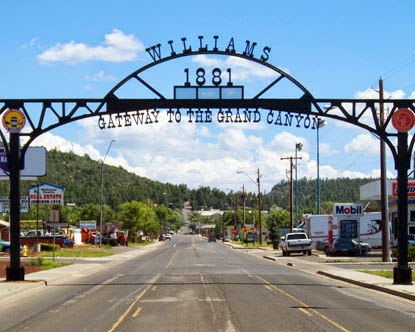
Williams, AZ

Day Fourteen

Got up and headed to the Grand Canyon somewhat early after breakfast at the Resort. After the usual Visitor’s Center purchasing of the totems we walked up to the South Rim – magnificent beyond word. We walked along the rim until we reached the Geology Museum, and then began taking the shuttles, namely the Blue shuttle to food first (a rather late lunch around 3 at Angel. Nearby were historic buildings, lodges, studios, and other nifty things.) and then the Red Shuttle out to the end of the line – Hermit’s Rest – stopping at most of the overlooks along the way. Glimpses of the Colorado River below bely the true size – something that looks like a nickel actually encompassing the width of three football fields. On the way back we got sunset pictures before driving back in the dark to the Resort for a thoroughly mediocre dinner.

Grand Canyon

Day Fifteen

Woke up, got out of bed… and drove out of town. We made tracks towards Las Vegas, specifically the airport, to drop off mom. Stopped for brunch at bizarre, classic Route 66 diner. From the Grand Canyon this took a pretty long time, not getting there until after 3. After fond farewells we hit a grocery store on the outskirts of Vegas and stocked up for the desert. The two of us ended up getting into Death Valley rather late – after the ranger’s station had closed, and set up tent right as night began to fall. Having picked a tent site six months in advance, ours had shade, which would prove welcome. An attempt by Jess to do night photography with her camera (and my tripod) proved to no avail.

The Snowcap Diner in AZ

Day Sixteen

Saw most of what was easily accessible by car in Death Valley. Our campsite was near Furnace Creek, and so we drove out to the lowest elevation spot in North America, wandered salt flats, stalked pupfish, and looked at dunes. We decided to take a siesta back at the tent. The night before we’d put up the rainfly (due to proximate coyote howling) but it was actually quite pleasant when off. Siesta over we took to the Furnace Creek resort for showers (at their pool) and then got some sunset shots.  Another night of camp food (mmm sardines on bagels – Jess felt blegch) and an early sleep.

Death Valley

Day Seventeen

We drove, each taking a four hour shift, from our camp site to Pacifica. The first shift got us as far as Bakersfield and included some rather unsettling shuddery brakes on a windy road with a steep grade. Driving out of Death Valley was really quite beautiful – perhaps more so than the eastern part of the park. Up Highway 5 we got in before the traffic, did a big switcheroo of cars and belongings in Pacifica at dad’s house (who had been keeping Ross’ car), got word that mom arrived safely back in Boston, and we all eventually got home to our respective dwellings. 4,700 miles later.

Thursday, March 12, 2015

Five New National Memorials

There are only 30 National Memorials in the United States, and while many are iconic (The Lincoln Memorial, The Vietnam Veterans Memorial), a great many you've probably never heard of. You may not know Chamizal, Arkansas Post, or Fort Caroline. Here are my suggestions for five more:


1.      Twin Towers National Memorial, New York City, New York

I suspect this will become a National Memorial fairly soon. 2,977 innocent people lost their lives on the morning of September 11, 2001. The two reflecting pools that stand in the footprints of the original tower should serve as a dedication.


2.      Galveston National Memorial, Galveston, Texas

We had to learn about this 1900 disaster in school, it was so important. It remains, with somewhere between 6,000 and 12,000 fatalities the worst natural disaster not only in the United States, but all of North America. Reports of 500 dead to McKinley were thought to be exaggerations at the time. The current memorial could be expanded.


3.      National AIDS Memorial Grove, San Francisco, California

The AIDs epidemic of the 70s and 80s claimed the lives of tens of thousands. The Federal Government moved far too slowly to respond to this disaster, and many innocent lives were lost while Americans died due to stigma. This grove, in Golden Gate Park, should be elevated to a nationally recognized memorial.


4.      Wounded Knee Native Peoples National Memorial, Wounded Knee, South Dakota

In 1973 two Native Americans were killed in the Wounded Knee Incident, the most recent fatalities of the United States government against the continent’s native peoples. Nearly a hundred year before, at the outset of the reservation era, over 200 were killed in the last official massacre of Native Americans. The site should serve as a memorial to the countless hundreds of thousands who died as a consequence of America’s policies. Some form of proper memorial should be created.


5.      National Slavery and Colonization Memorial, Historic Jamestowne, Virginia


More than half a million (estimates suggest approximately 597,000) black Africans were brought to the United States as slaves. Slavery cost many their lives, and is as tragic, really more so, than Vietnam, WWI, WWII, or Korea. Not to mention those untold thousands who did not survive the voyage. As such, Jamestown Virginia, where the first 19 slaves were on what would be American soil, would be the appropriate location, to memorialize the tragedy of slavery on the continent, as well as the continent's colonization. More emphasis on America's incipient slavery should be provided at the current site.

Sunday, March 1, 2015

#NaNoReMo 2015

The exceptional John Wiswell, of The Bathroom Monologues, came up with a great idea back in 2012 of National Novel Reading Month. During this month you read a novel that you've been meaning to get to. Something that's been sitting on the shelf for an awkward amount of time. Something you're supposed to have read.

So far for NaNoReMo I've read:

2012 - A Passage to India by E.M. Forester (I'd only recently gotten a hold of it, to be honest, but meant to get to it for a while.)
2013 - Invisible Man by Ralph Ellison (On my shelf since 2008.)
2014 - Old Goriot by Honore Balzac (On my shelf since 2008.)

And now for 2015: The Hunchback of Notre-Dame by Victor Hugo. (On my shelf since 2008.) This will, incidentally, complete my trilogy of books that I picked up in Natick, MA many years ago and never bothered reading. It will, like the past three NaNoReMos, also be my first work read by the author. I suppose I read a chapter of Les Miserables, once, but still...

So. If you're playing along, you have until March 31st to read your novel. Feel free to post your choices in the comments. I'm looking forward to what folks are finally tackling.

On a personal update: When it comes to reading, this year has been surprisingly slow so far; likely due to a focus for these first two months on movies . My cabin isn't well suited to reading, but some progress has been made, including Washington Irving, Rabindranath Tagore, and Anthony Powell. Also working on reading more science this year, last year having read far too little in that field. Currently reading Richard Feynman's Six Not-So-Easy Pieces, with Primo Levi on stand-by.


Thursday, February 19, 2015

My Own Ten Commandments

Any good commandment should, presumably, be rational. If it were irrational that’s a problem – because then any irrational claim can be made into a commandment. You need to be able to think about it and have it, basically, make sense.

Of the typical Decalogue, from the Bible, most of the commandments are pretty crap. I’ll presume a basic familiarity – you can look them up if you’re unaware of them. Let’s examine, as per Christopher Hitchens, why most of them are problematic:

1 + 2. “No gods before me” and “No graven images”. Neither of these are ethical advice – they are injunctions, and we can skip them outright.
3. “God’s name in vain”. What does this mean? No one seems to have consensus on this, which is sketchy, for a set of commandments if there’s interpretation and wiggle room.
4. “Keep the Sabbath”. Saturday, presumably, not Sunday. If God doesn’t exist, though, this is obviously meaningless. We want commandments that apply universally.
5. “Honor thy father and mother”. Interesting idea – unless your father and mother are dishonorable. Or abusive? What then?
6. “Thou shall not kill.” The Bible directly contradicts this. Like, a lot. Which is a shame, ’cause it’s a good one.
7. “Thou shall not commit adultery.” Not a bad idea. Not too practical, sadly.
8. “Thou shall not steal.” Good advice.
9. “False witness”. Also a good one – bearing false witness against thy neighbor is reprehensible.
10. “Coveting”. Lots of problems: 1) Equating women with farm animals, 2) Punishes “thought crime”, 3) Goes directly against human nature.

There are those who, on the contrary to the final point above,  argue that it is our human nature to murder, steal, and so forth. I don’t think this is the case. I doubt civilization would have risen to where it is without some basic understanding of what makes society work. As some have said – I doubt the Jews would have made it to Sinai unless they already had some understanding that murder is wrong.

We have some basic, obvious, moral understanding, therefore, regardless of the Bible. We know, without the Bible telling us, that slavery is wrong. So since ethics can be rationally arrived at, without the “good book”, let’s arrive at some rationally-based ethics.

Salvaging what’s still useful from this mess, I find there are three good commandments worth saving, and, since the order doesn’t seem to matter, I’ll make them the first thee commandments of my own list, updated slightly for 21st century language, and slightly improved:

1.      Thou shall not kill, torture, or eat other human beings.
2.      Thou shall not steal.
3.      Thou shall not bear false witness against other people, and shall respect the privacy of all persons.

Now for the obviously immoral omissions:

4.      Thou shall never own another human as property.
5.      Thou shall not commit or threaten sexual violence, nor engage in sexual activity with thy family.

I mean, incest, rape, and slavery are all pretty obvious – and yet somehow didn’t make the top ten. The next one is also fairly obvious, but a bit difficult to phrase concisely. So I’ve adapted the language from the UN Universal Declaration of Human Rights:

6.       Thou shall treat all persons as being born free and equal, in dignity and rights, without any distinctions.

On to some clearly praiseworthy notions, which, upon a little reflection, should strike folks as very good ideas for any society:

7.      Thou shall not harm children, and thou shall protect all children from harm.
8.      Thou shall allow all to practice freedom of thought, opinion, and expression – and thou shall persecute any who despise such freedoms.
9.      Those who do not follow these commandments will be considered criminals. Criminals shall be treated without cruelty, and with the aim of rehabilitation to rejoin society productively. If serious, prolonged attempts at rehabilitation be impossible, thou shall separate them from society indefinitely.

And finally:

10.  Thou art an animal, and shall live accordingly – as a mindful steward for the perpetuation of the Earth and the protection of the environment.


Personally, I think the adoption of these ten would mark a vast improvement moving forward into this young century, and beyond. It's not a perfect list, perhaps, for for a top ten I think it works.

Tuesday, February 17, 2015

Academy Award Animated Shorts 2015

So this evening I took a page from sister's style of blogging and joined her in downtown SF to watch the nominees for the Academy Award for Best Animated Short. In the past I went ahead and watched, and ranked, every winning short - and generally I wait until after the awards, forgoing the nominating processes, and nominees. But I love animation, so I was certainly down to see them.


The first short on the docket was "Me and My Moulton". Norwegian animator Torill Kove makes another appearance, having won in 2007 for "The Danish Poet". That short film is a pleasant, reflective piece of nostalgic reminiscing and story-telling. This year's entry is rather different. There is more humor, and of a broader sort. It deals with three girls whose father is an architect and whose mother buys them clothes from Finland. It's fun, and funny. Artistically - just in terms of line and color - it is difficult to judge. The aesthetic fits the story, but lacks some of the distinction that made "The Danish Poet" stick out in my mind.


Next we saw "Feast" - this year's Disney offering. A few years ago Disney won the award with "Paperman", their 40-year comeback piece. Last year they entered "Get a Horse!" which did not win. "Paperman" was directed by John Kahrs, and "Feast" is directed by Patrick Osborne and Kristina Reed. Yet despite different directors, "Feast" feels, essentially, the same as the 2012 winning submission. "Feast", again, has a broader humor, and visually is different - moving away from the black and white choices of the past two years to full color. Further, "Feast" takes a more Pixar feel by placing critical detail int he background. (Pixar, incidentally, hasn't been up for an award since 2011, and last won in 2001.) And yet, and yet, and yet... It's still a sappy-ish love story.


Third up was "The Bigger Picture" from the UK. This is an impressive feat. The animation is relatively unique (I'd never seen anything like it, my sister claims having seen an analog) - by painting full-size murals on the wall, and using stop motion when something needs to exist on a third plane. At the start of the film they had fun with the innovation technique, but midway through focused entirely, it seemed, on the story. The story was not particularly fulfilling, or interesting - two grown brothers look after their aging mother, one is upright but unmotivated, the other a cad with ambitions, and so forth. It's handled alright, but it did start to drag, despite a 7 minute length.


Penultimately we saw "A Single Life", credited by the Academy to Joris Oprins, from the Netherlands. With a very short running time this tells a quick, amusing story. The conceit is not new, and the animation is not striking - with a typical 3D look to it. It had amusing moments, and the ending was bold, but in all there was little to offer with this somewhat repetitive film (that is, a style that's not engaging, humor that's not too intelligent, and themes that have time and again received Academy nods in this field.)


Fifth and finally, there was "The Dam Keeper" by Robert Kondo and Dice Tsutsumi from the US. In 2008 a similar sort of film won, from France, called "La Maison en Petits Cubes". There's a foreboding, almost apocalyptic sense in the background. In "Maison" the sea-level has clearly risen to become almost uninhabitable; in "The Dam Keeper" there is a mysterious black smoke that, unless the dam windmill is kept running, will enter the valley below. The dam keeper is just a child, and deals with regular child problems beyond having to keep the valley safe. The animation, though, is very well done - and finally acknowledges a style (it was done with 8,000 paintings) that has been long admired in the animation world, but seemingly unworthy for consideration by the Academy. Beautifully done, but unfortunately the story, again, is a bit of a drag at 18 minutes.


So. Who should win?

Honestly, with the exception of "A Single Life" I don't mind. What "The Dam Keeper" and "The Bigger Picture" lack in story-telling efficacy they more than make up in visual appeal. "Feast" is a wee bit trite, but I kept laughing throughout. "Me and My Moulton" covered new ground for Torill, despite having already won for, in my estimations, a better film. I guess, if I had to choose, I'd go with "The Bigger Picture" just base dont he sheer novelty of the style, and as an encouragement for others to approach animation differently.

Post Script

There were other animated shorts included, although not nominated. I'll deal with them in brief.

First: Sweet Cocoon. I did not care for this drawn-out joke of a fat lady caterpillar trying to squeeze into her cocoon. The ending, albeit amusing, wasn't sufficiently original to justify the first six minutes.

Second: Footprints. I like Bill Plympton, but gosh is he a required taste for his animation. Something like if 'Zap Comics' became a little more surreal?

Third: Duet. Cheesy as all heck, but admittedly very well animated - nothing too special. Didn't run too long, though. Reminiscent of 1940s Disney.

Fourth: Bus Story. Amusing, vacillates between twee and outright morbid, so something for everyone, I guess. I swear I've seen other things by the director 'Tali', but can't think of any. Perhaps it's just the recognizable NFB brand of Canada.

Monday, February 9, 2015

A Valentine’s Day Retrospective

It's been ten years. Let's see how I've fared with this abominable day:

2005

My first girlfriend and I started dating in October of 2004, my Freshman year in college. We dated for most of the Fall, and over the Winter break we did separate internships. I went to live in a Zen Buddhist monastery. It was there, via email, on February 14, that I was informed after having a ‘discussion with Jesus’ she could no longer pursue a physical relationship with me. My first girlfriend dumped me on my first Valentine’s Day.

2006

I was single.

2007

Living in Leeds, England, I skyped with my girlfriend in the States, who had received my Valentine’s Day gift, and thanked me for it. I thanked her for the copy of The Film Snob’s Dictionary, which I secretly was offended by.  She proceeded to break up with me a week later. I learned a few months down the line that, as of that Valentine’s Day she had already begun cheating on me.

2008

I was single.

2009

This was the Valentine’s Day I spent in New York’s Port Authority. I’d not caught my flight out of Albany, and so was taking Greyhound to South Carolina, instead. (They *literally* said the next available flight wasn’t until Tuesday.) As I got into the infamous Manhattan station, of which I was already well-familiarized, I called my girlfriend, who was in NY at the time for an internship. She was wonderful enough to meet me down there, and wait in line with me at, like, 2 in the morning, and it was by far the best Valentine’s Day yet.

2010

I was single in Reno.

2011

I was single in Singapore.

2012

I was single somewhere.

2013

My girlfriend of the time lived across the state, near Hartford. I was in Madison, on the Connecticut shoreline. My work friends and I all went to Ashley’s place, and had a nice dinner. I had worked all that day, and was going to work all the next day, and couldn’t make it up to Hartford to see the girlfriend. I stole into the family den for a private phone call for us to say how much we wished we were with each other. A week later a box of See’s Candies arrived in the mail. This is my second-best Valentine’s Day.

2014

I was single.

2015


Well, I’ve got five days, folks…

Sunday, February 8, 2015

Song of the South

I was probably six or seven the first time I went to Disneyland.

Many of the rides that were my favorite then were kiddie-oriented. I loved the Tiki Room, for example. (Oddly, years later in 2012 with my recent-ex and a college buddy, we went there on the 40th anniversary of the Tiki Room - one of the most low-key events ever put on in the park-grounds, I should expect.) And yes, as a kid I liked It's a Small World, and closed my eyes through the entirety of the Haunted Mansion. It was a grand time.

We went back a few years in a row, and then stopped. Perhaps my father's fortunes changed. I don't know. Maybe we just got too old, although I've subsequently enjoyed myself on the two occasions in my twenties when I've gone returned to the park.

But the point of all this is that, one of the rides I continually enjoyed over the years, was Splash Mountain. Even as a child I was somewhat analytic in nature, and I was intrigued, in a passing way, by the animatronic tale of the ride. I didn't know these characters of Br'er Bear, Br'er Fox, and Br'er Rabbit from the Disney movies I'd seen - and I'd seen quite a few. It was the beginnings of a mystery.

*    *    *

I grew up in a Disney family, and throughout my childhood I'd watched a lot of classic Disney movies. I loved Bedknobs and Broomsticks, Robin Hood, and many others. My dad, on the other hand, took advantage of the VHS phenomenon and bought Disney films from his youth. As such, I also grew up with the lesser-known Disney Classics such as Make Mine Music, Fun and Fancy Free, and The Three Caballeros.

One movie my dad kept waiting for was Song of the South. It was being screened in move theaters as late as the year I was born, 1986. But as the VHS releases came out during the 90s, it never got released. Nor was it put out on DVD when that format began to dominate.

The story of Song of the South was one of those little mysteries that rattled in the back of my mind. I knew, by then, that it was the source of Splash Mountain's story. It was forbidden, and so, naturally, I wanted to see it.

*    *    *

In 2013, over the summer, a then-friend and I discussed seriously creating a 'History of the Novel' course, as a high school elective. It could be taken as a history credit, my background as a social studies teacher providing legitimacy there, or an English credit, as my then-friend was in that field.

We therefore wanted to provide selections of novels that both showed the development of the format, as well as highlighting novels that played a role in history. I wrote up at the time our potential syllabus: Frankenstein, The Tale of Genji, Tarzan of the Apes, and the rest. One of those novels, of indubitable historic import, was Uncle Tom's Cabin. I'd never read the book, though, and so picked it up and began reading this so-called classic.

*    *    *

A month or two later, my then-girlfriend and I went upstate to Hartford to see the Twain house. My mother had told me stories as a child of what a wonderful mansion it was, and as a mansion-viiting type (previous excursions including Newport and Hearst Castle), I was used to, and fond of, these sorts of outings.

Once we arrived, after eating at a nearby Irish pub, we got tickets for a tour that was a double special, for it turned out that Harriet Beecher Stowe's house was literally the house next door to Twain's. I was, at that time, still reading Uncle Tom's Cabin, and I was interested in her life, even if the book was a drag. The 'History of the Novel' class, by now, had fallen through. It was already mid-September.

Most interestingly, actually, was the fact that she helped come up with modern kitchen design. Things you learn on a house tour.

*    *    *

As October progressed that year, everything fell apart.

First, in late September, shortly after our house tour, my then-girlfriend broke up with me. She had been something of a rebound, having started dating a month after a long-term relationship ended. In all we dated about four months. I liked her, but was wary when, the day before the phone call, she didn't go with me to the regional fair called the Big E.

My then-friend, who had gone with me and others to the Big E, was fired shortly thereafter for the most just reasons you could imagine. We've not spoken since, I defriended him the same day on Facebook, and was wary of anyone who kept contact with him. We'd been pals, but it was clear, as allegations mounted, and truth was out, I hadn't known him at all.

Two other people left the school that month, both poorly. The night we heard about my then-friend, people came to my apartment, brought beer, and commiserated. Life went downhill fast. It took a couple of months to recover.

By then I'd finished Uncle Tom's Cabin, and moved on to, as I recall, Fear and Loathing.

*    *    *

Some facts, first.

Between 1880 and 1907, Joel Chandler Harris, another friend of Twain's, wrote the Uncle Remus stories. Harris, like Stowe, was white. And like Stowe he was trying to paint a sympathetic portrait of African-Americans. Also like Stowe (and Twain), he tried to write dialect. That looked something like this:


The Disney film Song of the South, based on Harris' stories, was released in 1946, and although Harris stopped writing these Reconstruction-era fables (and subsequently passed away in 1909), new collections were being put forth as late as 1948 - well into the WWII-era.

Song of the South's most famous cultural achievement, of course, is the Academy-Award winning song, originally sung by James Baskett as Uncle Remus: 'Zip-A-Dee-Doo-Dah'. That song, for example, was released on VHS on Disney Sing-A-Long tapes. It's been covered by everyone from Louis Armstrong to Diana Ross and the Supremes and culturally referenced many times.

*    *    *

The other night, out of idle curiosity, I decided to solve this childhood mystery, and went searching for Song of the South online. I knew it had been released in other countries, and figured someone must've uploaded it.

Sure enough, I found it. I watched it, and I thought about it.

First things first, though, I should give a quick overview of the plot, since few Americans have ever seen the film, and the Splash Mountain version is very different from the movie. It goes something like this:

A boy (obnoxiously cherubic Bobby Driscoll), his mother, his father, and Hattie McDaniel take a coach to Grandma's house. On the way they stop in the forest and encounter a big, mean wolf...

Just kidding.

Anyway, they get there and dad leaves. Something is going on between him and the mom, with lots of tense looks, but this is never actually explained. The boy is distraught, and tries to run away that night, encountering instead Uncle Remus, telling stories. By this point in the film you sort of want the boy to run away, and maybe die of exposure, but sadly he goes back to Remus' sharecropper cabin, and hears first the song 'Zip-A-Dee-Doo-Dah', and then the story of Br'er Rabbit escaping one of Br'er fox's traps. Needless to say, this is the first animated section.

Moral is: you can't run away from trouble. I guess. 

So Bobby gets a puppy from a nice girl down the road, and then his total bitch of a mother makes him give it back EVEN THOUGH THE LITTLE GIRL GAVE IT TO HIM. Remus agrees to keep it in secret, and tells the story of the tar baby, with the apparent moral of not messing with things you have no business with... I don't know. We also get the song 'How Do You Do?' which Splash-Mountaineers will immediately recognize.

The mother finds out Remus hid it, and makes him give it back for reals this time. Seriously, by the end of this thing you just want to punch the mother.I don't even like the boy, but give him a break! Also they explicitly say, multiple times, that if they give the dog back to the original family they're going to drown it. Fuck racism, puppy-murderin' is a pretty good reason for Disney to bury this film. 

And so now the boy has lost his father and his dog, who loved him, and who, since we don't see him again, was presumably drowned. At least the boy has Uncle Remus to hang out with! Like, his only friend! But will his Cruella De Vil of a mother allow that? Of course not!

For some reason or another (there was a party, the family down the lane, there was a fight, yadda yadda) Remus has to console this poor kid yet again, and should seriously file papers for legal guardianship, telling the boy and the nice girl from down the road about the time Br'er Rabbit went to his laughing place, with the accompanying 'Laughing Place' song.

As reward for helping the children through their misfortunes, the mother forbids the kindly Uncle Remus from ever speaking to the boy again. So Uncle Remus runs away.

As we pile on the layers of loss and trauma on Bobby Discoll's golden-locked head it was only a matter of time until the child would eventually snap. He runs after Remus, gets gored by a bull, and dies.

Almost.

On his death-bed, he calls for Remus, who is found, and who, through the power of his story-telling, IS ABLE TO REVIVE THE BOY FROM THE BRINK OF DEATH ITSELF. Uncle Remus is, literally, supernatural. At this point the boy's dad has come back from wherever the fuck he was, and when the boy revives Remus goes way again to leave the family to reconcile. He is a black man, after all. Wouldn't want the man who saved your son's life to muck up the whole thing by being all black and present, would we?

Then they all become delusional and start seeing the animated world around them before, literally, skipping into the sunset.

*    *    *

So. Thoughts.

1) Holy shit is the boy's mother the Worst Parent Ever, or what? She does nothing to console her son when his father leaves, makes him give back his rightfully-owned puppy to be drowned (the puppy that helped him get through these hard times) and then says he can't be with his only friend. Total. Bitch.

2) And far more importantly, is it racist?

In a nutshell - yes.

But it's more complicated than that. First, unlike Dumbo's crows, say, the Br'er trio is actually voiced by black voice-actors. So that's progress. Yet the animated villains of the fox and bear are pretty awful stereotypes. The fox, not surprisingly given the role of foxes in fairy-tale and fable, is the cunning one. He is the stereotypical fast-talking overly-cocky character. The bear is a dummy. He's not Stepin Fetchit-levels of racist, but it's pretty bad.

But these are villains. I could diatribe for a long time about how Disney portrays its villains in stereotypical formats. What of the main story, though, the live action? Is it racist?

One common misconception held by those who've not seen the movie is that Remus is a slave. This is not the case. The story clearly takes place during Reconstruction, and there are multiple scenes of the plantation's African-American inhabitants living as sharecroppers. 

The closest analog for Uncle Remus, not surprisingly, is with Uncle Tom's Cabin. I have, as mentioned, read this work, and it's difficult to describe for those who've not read it. We look on this book, these days, as racist. But at the time the intent was to paint a sympathetic portrait of African-Americans. Harris' Uncle Remus is the same, and in the Disney adaptation, this is the tenor of the live action sequences. After all, given the story, Remus is consistently doing the right thing, and consistently is the hero. I honestly think Disney wanted to tell a positive story about African Americans.

That said, it is still very problematic by today's more enlightened standards. The clincher in this, really, is when Remus decides to run away. I mean, he's a grown man who's just been told off by this awful woman. A child would run away - why would he? He still has family, and plenty of other children to tell his tales to. It just doesn't quite make sense, and feels off in the film.

I  get that Disney was trying to do the right thing, but these days, due to the plot, the animated villains, and the still-unfortunate use of dialect, it's rightfully seen as racist.

3) Should it be made public in America?

Yes.

It's not one of Disney's proudest moments, but then again neither are the black crows in Dumbo, or the Native Americans in Peter Pan, the Siamese cats in Lady and the Tramp, or half a dozen other such things. Nowadays Disney has released disclaimers about these portrayals. Unlike, say, the black centaur in the original Fantasia, the point of the humor in Song of the South is not to laugh at black Americans. The elements that we see now as clearly troubling in Song of the South were never at the expense of Uncle Remus.

So frankly, since the intention wasn't for a cheap racist joke, and since many Disney movies that do have cheap racist jokes in them are seemingly fine to be released, let's just go ahead and put it out there. Slap a disclaimer on it, and release the thing already. It might be good to have the cultural discussion. 

If nothing else, Splash Mountain will now make a lot more sense.