Tonight ended a list. I have now seen every movie to win Best Picture. Here is my ranking.
First, the basis on which I ranked them, and a very good basis, was "Would I want to own this?" If I opened the wrapping at Christmas, to discover this movie inside, how would I feel about it? As such:
A+ : Classic
A
: Great Movie; Want to Own/Do Own
A- : Very Good Movie; Want to Own/Do Own
B+ : Good Movie; Wouldn't Mind Owning
B
: Solid Movie; Wouldn't Mind Owning
B- : Pretty Good Movie; On the Fence for
Owning
C+: Alright Movie; Meh Owning
C
: Average Movie; Meh Owning
C- : A Little Under Average Movie; Not
Like to Own
As Umberto Eco pointed out, lists are our way of avoiding death. By giving order to the world, and organization - by making rational sense of it - we avoid our own death. I'll quote him, from an interview in 2009 with Spiegel Magazine: "SPIEGEL:Why do we waste so much time trying to complete things that can't be realistically completed?
"Eco: We have a limit, a very discouraging, humiliating limit: death. That's why we like all the things that we assume have no limits and, therefore, no end. It's a way of escaping thoughts about death. We like lists because we don't want to die."
How we organize our time was a particular interest of the 20th century Existentialists. Unlike their early fore-bearers, such as Nietzsche or Kierkegaard, time became all the more important when faced with the modernism of the 20th century. The simple pace and rate of change required a new philosophy. Some wrote academically about the changes in the world around them, such as Walter Benjamin's famous essay on "The Work of Art in the Age of Mechanical Reproduction" from 1936. As he writes in the first sentences:
"In principle a work
of art has always been reproducible. Man-made artifacts could always be
imitated by men. Replicas were made by
pupils in practice of their craft, by masters for diffusing their works, and,
finally, by third parties in the pursuit of gain. Mechanical reproduction of a
work of art, however, represents something new. Historically, it advanced
intermittently and in leaps at long intervals, but with accelerated intensity."
We are, of course, hyper-aware of the reproduction of things. It defines our world, fundamentally. We are made aware of it from earliest childhood.
Shot from a Sesame Street short about the crayon factory.
How many recognize this Looney Tunes tune?
Best not to ask...
Still a proud tradition in cartoons today.
We are inculcated with the assembly line from our earliest youth. The mass-production side of modernism that perfectly duplicates and makes carbon copies of the world around us. How could the doubling of our world not affect our view of it?
So, too, did notions of space and time change enormously at the start of the 20th century. Flight, skyscrapers, cars, trolleys, telegraphs, telephones, gramophones, motion pictures, and time zones all were invented, or popularized, in a very short period, from 1880 to the 1930s. One lifetime - not even. Most of these inventions helped to collapse distance and minimize time. Think of the novels of the era which we still love that deal with time travel (The Time Machine by HG Wells, 1895) or the conquering of distance (Around the World in 80 Days by Jules Verne, 1873, challenge undertaken and beaten by Nellie Bly in 1889). Books about change abounded (The Magnificent Ambersons by Tarkington, To the Lighthouse by Woolf, Looking Backward by Bellamy, etc.) during these years, and artistic styles kept pace.
As the physical world muddled notions of space and time, including artistic mediums such as film, other mediums were interested in modernity's fast pace. The Futurists, especially, caught the bustle and difficulty of attempting to render the new pace of the age on a static canvas, or solid statue:
Dynamism of a Dog on a Leash, 1912
Unique Forms of Continuity in Space, 1913
Bird in Space, 1923
All of this hustle and bustle was to be found in the foundations of our reason, as well. In the mid-1800s non-Euclidean geometries were developed by Lobachevsky and Riemann. This laid the groundwork for the breakthroughs in physics of the modern era (Lorentz, 1899; Einstein, 1905; Minkowski, 1907; de Broglie, 1924; Heisenberg, 1930) that dealt with the issues of space-time and quantum mechanics. How much more fundamentally can space and time be altered than relativity and quantum theory?
Even logic, itself, underpinning science, mathematics, and philosophy, was undergoing a revolution in the modern era, with significant advances and updates to structures fundamentally unchanged since Aristotle's time (Frege, 1879; Whitehead and Russell, 1913; Godel, 1931). With such a revolution taking place at levels, in all forms of knowledge, expression, and experience, it is therefore not surprising that the 20th century Existentialists differ radically from those of the 19th century.
* * *
The issue is time, and what to make of it.
For Heidegger, whose ontological treatise Sein und Zeit, Being and Time, the focus, it would seem is mainly on being, and more importantly being-in-the-world. How we exist int he world in fundamental to understanding Heidegger's thought - for the manner of our existence is rather odd. To quote myself, from this blog five years ago, discussing a Heidegger moment:
"So while I was walking my mind was 'far away', as they say. (Stop and consider the philosophical connotations of such a phrase, in relation, as it usually is given, to one's mind. That's Heidegger.) My thoughts were pleasantly fantastical at the moment in question. A middle-aged Asian fellow walked briskly past me, requiring me to shift on the sidewalk, and pay attention to my footing.
"I was peeved. I had been thinking fun thoughts, and this fellow had forced me to stop and think about my legs and feet!"
After the influence of Heidegger in the 20s, the next big Existential thinker was, of course, Sartre. Sartre's magnum opus is Being and Nothingness. Sartre said the important thing is to have projects: more specifically, projects of the self.
For a long time I eyed people with "causes" with suspicion. It was rooted in Sartre. People subsume their selves to a cause, to an artificial project. "Subject" is the right word, perhaps, both as verb and noun.
As Eco said, lists are a way of avoiding death. For the Existential thinkers, death is key. In the modernism of a rushing, whirling, time-and-space up for grabs world death became a more obvious, eternal constant, I should think. Celebrate the here and now, for the solemnity of death in eras gone by will be magnified by a new sense of loss of novelty: the dead won't get to see next year's fashions. (This is a notion Leopardi hit on in his conversation between fashion and death, written in the 1820s - perhaps the grandfather of the existentialist writings.)
Sartre basically said that we embroil ourselves in false projects, things that seem important, all the time. Some are quests we make our mantles for years, others, a trip to the hardware store, to fix that light in the pantry. From the political platform to the shoe-box diorama, life is full of projects. Distractions from our own existence. Only those projects that help us discover ourselves, more or less, are the one's worth pursuing, argues Sartre.
For three years, starting on this blog back in 2012, I got interested in writing about campaign finance reform, the Millennials (whom I dubbed 'the Loser generation', a connotation I stick by), and how screwed up both Congress and the economy are. I wrote a whole book on it in the interval.
The book, at least the first significant draft, is done.
But was it a project that helped me discover my self? To put the issue in philosophically grounded language, that I should hope a dedicated laywoman would understand, I borrow from the Internet Encyclopedia of Philosophy:
"The way in which the incoherence of the dichotomy of facticity and freedom is manifested, is through the project of bad faith (chapter 2, Part One). Let us first clarify Sartre's notion of project. The fact that the self-identity of the for-itself is set as a task for the for-itself, amounts to defining projects for the for-itself. Insofar as they contribute to this task, they can be seen as aspects of the individual's fundamental project...
"...all projects can be viewed as parts of the fundamental project, and we shall therefore focus upon the motivation for the latter (chapter 2, Part Four). That a for-itself is defined by such a project arises as a consequence of the for-itself's setting itself self-identity as a task. This in turn is the result of the for-itself's experiencing the cleavages introduced by reflection and temporality as amounting to a lack of self-identity. Sartre describes this as defining the `desire for being~ (BN, 565). This desire is universal..."
This is why the Existentialists are the rightful inheritors of the Socratic world, to know thyself...
Did my book help this particular 'for-itself' with self-identity, or was it a project of 'bad faith', with the scorn I'd laid at the feet previously of those suspicious individuals who took up causes?
Was this project not just a means of wasting time? If, truly, the discovery of ourselves and the contemplation and actions base don our raw existence is the most important thing, then the answer is a simple affirmation that I did indeed waste a lot of time. When Sartre sat to write Being and Nothingness he was engaged in a form of self-identity and discovery, no doubt, that I cannot claim with my book on campaign finance. My world view shifted, somewhat, in a way Heidegger might appreciate, but not, perhaps, Sartre.
In a modern world, isn't it so much harder to reject the novelty, the changes, the assembly-line of life? Aren't all the forces and factors of our society pushing us towards embracing the distraction, and marveling in the marvelous marvels around us? The early modernists, in the era I described before, understood this. Their camera lenses whirled and whizzed and blurred and plunged. They captured the chaos. Perhaps the definition of post-modern, which we are still reluctant to embrace and avoid, generally, is that we no longer are surprised by the new. "Nothing new under the sun" actually makes sense to us. We've managed to create an incredible rate of change, and to approach it with the indifference of Egyptian priests, of a thousands-year old tradition of unbroken pharaohs, sunrises, and the Nile.
* * *
When I finished writing it, this long project, I faced a new void.
As a list-maker, I like to organize and rationalize my world. But the Existentialists had too profound an impact on me - I can't shake them. And when faced with a modern void, unlike the abyss of Nietzsche (d. 1900) I turn to Camus.
Camus wrote two important works for philosophy. The first stated that the question is suicide. If the universe is unfeeling, life, in the truest sense, meaningless, Godless, and bounded by an unchosen birth and an inescapable death, don't we have to seriously contemplate the act of living - of existing? These views are brought forth in his The Myth of Sisyphus and aren't even that new. Schopenhauer and Hume, and others, had already debated along similar lines the importance, philosophically, of suicide. Camus just updated the work to fit the times.
His later, and more important work, was The Rebel. Sisyphus was written in 1942, and The Rebel in 1951. In it he argues that, okay, so life is absurd. but isn't this actually a contradiction - a nihilism in sheep's clothing? You can't actually believe that life is absurd, and so we rebel. And this rebellion takes numerous forms - basically, we want justice, and there is none. So some rebel with crime. Some with revolution. Some fastidious Russian assassins attempted to justify their taking of life through terrorist bombings with the polite exchange of their own lives in return. Human existence is a story of injustices, and revolutions and terrorist gangs none too appealing (despite their claims to legitimate rebellion).
Was my book an act of rebellion? I doubt it. I want to start a revolution, it is true. I wrote the work to read as a manifesto, a memoir, and a logical synthesis, or summary, of the world today: a vision of clarity and insight to rock our society. Tangibly, the cause I'm writing against is an injustice. The domination of one group of peoples by another.
In between these two philosophical works, Camus wrote his best novel, The Plague. This is the most accurate literary phenomenon of the existential tradition. It acknowledges the absurdity, and continues on.
* * *
My book is finished, for now. I have ended the project, and for a while forgot death. Now the absurdity of life continues on, and the only real choices I have are whether to engage in another "cause" of the bad-faith sort, or one of self-identity. To rebel against unfairness of our condition in a meaningful way, or a construct. Bore myself in a postmodern phantasmagoria or try for existential reckoning with the whirlwind - a whirlwind of space and time. A carnival...
"And the music came back with the carnival, the
music you've heard as far back as you remember, ever since you were little, that's always playing
somewhere, in some corner of the city, in little country towns, wherever poor people go and sit at the end
of the week to figure out what's become of them. "Paradise" they call it. And music is played for them,
sometimes here, sometimes there, from season to season, it tinkles and grinds out the tunes that rich
people danced to the year before. It's the mechanical music that floats down from the wooden horses,
from the cars that aren't cars anymore, from the railways that aren't at all scenic, from the platform under
the wrestler who hasn't any muscles and doesn't come from Marseille, from the beardless lady, the
magician who's a butter-fingered jerk, the organ that's not made of gold, the shooting gallery with the
empty eggs. It's the carnival made to delude the weekend crowd.
"We go in and drink the beer with no head on it. But under the cardboard trees the stink of the waiter's
breath is real. And the change he gives you has several peculiar coins in it, so peculiar that you go on
examining them for weeks and weeks and finally, with considerable difficulty, palm them off on some
beggar. What do you expect at a carnival? Gotta have what fun you can between hunger and jail, and take
things as they come. No sense complaining, we're sitting down, aren't we? Which ain't to be sneezed at. I
saw the same old Gallery of the Nations, the one Lola caught sight of years and years ago on that avenue in
the park of Saint-Cloud. You always see things again at carnivals, they revive the joys of past carnivals. Over
the years the crowds must have come back time and again to stroll on the main avenue of the park of SaintCloud
. . . taking it easy. The war had been over long ago. And say, I wonder if that shooting gallery still
belonged to the same owner? Had he come back alive from the war? I take an interest in everything. Those
are the same targets, but in addition, they're shooting at airplanes now. Novelty. Progress. Fashion. The
wedding was still there, the soldiers too, and the town hall with its flag. Everything. Plus a few more things
to shoot at than before.
"But the people were getting a lot more fun out of the Dodge'em cars, a recent invention, because of the
collisions you kept having and the terrible shaking they gave your head and innards. More howling lunatics
kept pouring in for the pleasure of smashing ferociously into one another and getting scattered in all
directions and fracturing their spleens at the bottom of their tubs. Nothing would make them stop. They
never begged for mercy, it looked as if they'd never been so happy. Some were delirious. They had to be
dragged away from their smash-ups. If they'd been offered Death as an extra attraction for their franc,
they'd have gone right in. At about four o'clock the town band was supposed to play in the middle of the
carnival ground. It took some doing to collect the musicians, because of the neighborhood bars, all of which
wanted a turn at them. A last one was always missing. The rest waited. Some went looking for him. While
waiting for them to come back, the others would be stricken with thirst and two more would disappear.
They had to start all over again.
"Incrusted with dust, the gingerbread pigs turned into relics and gave the prize-winners a devastating thirst.
"Family groups are waiting for the fireworks before going home to bed. Waiting is part of the carnival too.
Thousands of empty bottles jiggle and clink in the shadow under the tables. Restless feet consent or say no.
The tunes are so familiar you hardly hear the music or the wheezing motor-driven cylinders behind the
booths, which put life into things it costs two francs to see. When you're tipsy with fatigue your heart
pounds in your temples. Bim! Bim! It beats against the velvet around your head and inside your ears. One of
these days you'll burst. So be it! One of these days, when the movement inside catches up with the
movement outside, when your thoughts scatter far and wide and rise up at last to play with the stars.
"A lot of crying went on all over the carnival, children getting accidentally squeezed between chairs and
others being taught to resist their longings, to forego the enormous little pleasure of another ride on the
merry-go-round. For character building the carnival hasn't its equal. It's never too soon to start. The little
darlings don't know yet that everything costs money. They think it's pure generosity that makes the
grownups behind the brightly lit counters incite the public to treat themselves to the marvels which they
have amassed and which they guard with their raucous smiles. Children don't know the law. Their parents
slap them to teach them the law and protect them from pleasure.
"There's never a real carnival except for the shopkeepers, and then it's deep down and secret. The
shopkeeper rejoices at night when all the unsuspecting yokels, the public, the profit fodder, have gone
home, when silence returns to the avenue and the last dog has squirted his last drop of urine at the
Japanese billiard table. That's when the accounts are totted up, when the shopkeepers register their
receipts and take stock of their powers and their victims."
Louise-Ferdinand Celine, The Journey to the End of the Night, 1932
* * *
Has the writing of this post been an exercise in turning away? An act, a project, of bad-faith, to avoid my decision a little longer?
I was an early adopter when it came to dating online.
Being somewhat malaligned with societal values, and those of my age bracket specifically, it was an obvious choice. I groomed-up my first dating profile in 2010, and for five years I've been casting my net, on and off. I've tried OKCupid, EHarmony, Plenty of Fish, How About a Date, and in unspeakably dark corners of the basement of my soul, Craigslist. I know there are more, but I can't for the life of me recall them now.
Teetotaling twenty-somethings are rare. Moving around constantly also meant no permanent friend base, or social group - having to restart from scratch again and again. I am the member of no church, society, or organization. There's always work - but there's been a dearth of nice young ladies, thanks to historical caprice, at the places I've worked. So online dating has account for almost all of my interactions and encounters since I left college.
Online dating works. I've had some good relationships on there. I've made friends on there. But the dynamics are shifting. It's no longer just the early-adopters on these sites, who were similarly inclined to put themselves out there, meet up irl, and share a clearly compatible view of dating.
When I moved back to the Bay Area in August I was excited for dating again. Connecticut had been okay, but a little rough. Yale grad students are great, but you start running into people after a while...
Unfortunately, the last nine months have not been kind. Why this is, I don't know. Maybe I'm too old, now, at 28. Maybe it's 'cause I'm in the outer Bay Area - and not in SF proper, or Berkeley. Maybe I've grown uglier. Who knows. At any rate, the old sites weren't pulling their weight.
So the other day I gave up and got Tinder.
For most of my online dating I've used OKCupid as a default. It has a short page where you fill in your stuff - favorite books, what you do for a living, what you're good at, etc. Tinder, by contrast, gives you something like 500 characters.
And there's no percentage system. You just swipe right if you like them based on their pics and a paragraph.
Now, with such a simple (and from my experience so far, horribly flawed) system, you may think most people would master it really quickly. Nope! Not at all. In fact, a great many are astoundingly bad - and this is the curse of the increased popularity in online dating, and Tinder especially. I almost want to make a fake profile just so I can tell girls what they're doing wrong:
1) In the first photo, make sure it's just you. If there are two girls in the photo (or more!) then I don't know which one is you. This is highly annoying, because now it's detective work to discover which one you are, scrolling through your pics, usually with a bunch of girls in each. I am not psychic. If I was I wouldn't be on a dating site. Just because you know who you are in the pic, doesn't mean anyone else does.
2) That said, have at least one pic with friends. I'll swipe right, regardless, if you're attractive. But if they are all just you - and especially if they are all just selfies of you - I will assume you have no friends. Limit yourself to, let's say, two selfies. Max.
3) You must have at least one body shot, and one face shot. The wearing of sunglasses/an over-sized hat, being totally obscured by shadow, or wearing a Halloween mask disqualifies as counting for your face shot. Tinder is shallow. If you're not a looker put that out front and look for quality guys who got turned around and ended up on this wretched application. Otherwise some dude will message you, you'll go on a date, and there'll be mutual disappointment. No one wants that. That's the worst. I've been there, on both sides. Same goes for the body shot. It can't be from more than three yards away, either.
4) In general, have varied shots. Six shots in a row of you at the bar? Six shots in a row at the beach? Six shots in a row of you in front of awe-inspiring vistas? Please. Show off that you do more than one thing with your life. Unless you're a Mozart-type who is, in fact, totally obsessed by a single aspect of the world, in which case, great. And keep them up-to-date - when we meet you, we will be able to tell. Tigers, the Grand Canyon, and the shooting range are henceforth outlawed as being too unoriginal while still desperately trying to be original.
5) If there are small humans under the age of 12 in the shot you must declare that you are not a mother, or be honest and say you are, if that's the case. Parenthood is a deal-breaker for the vast majority of men. So if the guy is looking for a relationship, and then finds out you have a kid, will he stick around - especially when you kept such a big and important secret from him? Likely not. And if he's not looking for a relationship, but just a wham, bam, thank you ma'am, then he won't care if you have a kid or not, 'cause he'll be gone by the end of the week, or even before pancakes. So be up front.
That covers the photos. Now onto the words:
6) Say something. I grant you, if you're attractive, dudes will swipe right anyway. But come on. Do you want cheesy pickup lines as an opener? What else have you given us to work off of - especially if your photos are basic. "So... I see you like the beach..." And don't be wrist-slittingly depressive! "I fucking hate my life" is not getting me jazzed to meet you. Further, "I don't know why I'm on this site..." and the like are also not winners. Be confident, dammit! Guys like it too.
7) Avoid the basic stuff. You like FUN? HOLY SHIT - I LIKE FUN! That is in no way subjective, and totally unnecessary to state! Seriously, think about it. What do you like doing - more than once a year. A couple of tips: 1) If you mention God, Jesus, Christianity, [your denomination - unfailingly Catholic] thank you. We are also going to assume that if you put it in your 500 characters you go to church weekly and are really into it. 2) Don't say you like to drink X. More than likely there's a photo of you drinking, right? You're wasting words. 3) Show it, don't state it. Can't believe I'm giving out high school English advice, but it creates more of an impact in writing when you demonstrate rather than state. Classic case in point: don't say you are funny - prove it. Don't say humor is important, show me. Tell a joke, a pun, a bon mot, some sarcasm, whatever.
8) No male cares about your sign. No one, no one, no one. The one's who say they do are liars and brigands, or are of a weird, small minority that wears dreads and drinks kombucha.
9) I don't know why Tinder is height obsessed, but whatever. Since everyone else is doing it, I guess we all should. Maybe it's because people take stupid pictures with no frame of reference by which to gauge their real height... Hmmm...
10) Avoid the fucking emojis. As an Android user this is especially true - I can't see any of them. Also: vast majority of guys won't think it's cute/care. I WILL wonder about your powers of communication and speech. This goes along with all the usual decrying of poor grammar, punctuation, etc. You will be judged as unintelligent and incoherent if you can't write sentences. Oh! And make it coherent, topically, as well. I've seen too many weird profiles where it says things like "I am studying in Utah" or "I am new to the Tampa area". Who or what are you, and why are you posing as a Bay Area girl?
But that's more than 500 characters,
I'm not sure what's next. Swiping, as many have said, is addictive. And it feels silly to cut oneself off from any means of finding people, especially after nine months of nothing beyond a second date.
God, it's depressing, though. It's everything we feared online dating would be - and it's going away no time soon.
Shorts have had a huge influence on my life, whether cartoons I grew up on, or art house productions I saw when grown up. That said, here are some amazing shorts, a baker's dozen of my favorites. Unlike other lists, they are not ranked. I've left out Disney cartoons, since I did that list back in 2013. So too cartoons that I talked about in my post of the Academy Award-winning animated shorts.
Everything Will Be OK by Don Hertzfeldt, 2011.
I have seen this so many times, Everything in it is right.
The Big Snit, Richard Condie, 1985.
So funny, so poignant. One that makes me laugh every single time.
The Love Life of the Octopus, Jean Painleve, 1965.
Painleve's odd nature documentaries are what I wish I'd grown up with.
(Make sure to turn on the English subtitles.)
Rose Hobart, Joseph Cornell, 1935.
This unusual but hypnotic film caught the surrealists off guard, including Dali who made such a scene (surprise) when he first saw it, it was buried for many years.
The Fall of the House of Usher, Melville Webber and JS Watson Jr, 1928.
Beautiful, atmospheric, silent film adapts Poe's classic story.
Powers of Ten, Charles and Ray Eames, 1977.
You've hopefully seen this one by now, but if not: wow!
Lambchops, Burns and Allen, 1929.
So clever. A quick look into the lost world of vaudeville, already adapted for the screen.
The Life and Death of 9413: a Hollywood Extra, Robert Florey and Slavko Vorkapich, 1928.
The early, experimental days of cinema were fun. This short gently makes fun of the whole Hollywood silent era, but actually is rather touching and sad at the end.
Paris Asleep, Rene Clair, 1925.
Experimental, silent, FRENCH - it's perfect! Actually, though, this is very amusing, and somewhat marvelous. Climbing on the Eiffel Tower, looking down at a city that has fallen, seemingly forever, asleep...
The Tell-Tale Heart, Ted Parmelee, 1953.
James Mason!
Minnie the Moocher, Dave Fleischer, 1932.
Betty Boop's greatest cartoon was, naturally, one of the three Cab Calloway numbers (the others being Snow White, and in a distant third, The Old Man of the Mountain).
Multiple Sidosis, Sidney N. Laverents, 1970.
So. Weird. So. Funny.
Night and Fog, Alan Resnais, 1955.
The masterpiece bar none of the French New Wave - the greatest documentary ever made - perhaps the greatest short film ever made.
We went on a long journey my sister, my mom, and I. Here is the transcript, in rough form, of that journey, noting that the photos are not my own:
Day
One
Drove
down from Boston to Shenandoah Park. Much of the trip was spent playing cars
games, collecting state license plates, etc. Drove across the Washington Bridge
to get past NYC. Got food on the road for lunch and dinner. Got down to
Virginia late – winding night road into the Park, snowy all along Skyline
Drive, eventually getting to Skyland. Very cold on arrival – gloves needed to
take luggage to the cabin. The cabin was probably from the 50s, done in knotty
pine, with a balcony to look onto the valley below.
Shenandoah
Day
Two
In
the morning we drove to the dining room of Skyland – named for our ancestor
George Pollock – and got a hearty breakfast to start, unfortunately seated by
the large, beautiful, and cold, picture windows. Drove along Skyline Drive for
a bit, taking pictures at pull-outs and did a quick little jaunt (500 ft or so)
along the Appalachian Trail at one of the overlooks. Exited the Park off
Skyline around noon and began driving through backroad Virginia. Along the way,
after a few hours, we stopped at Natural Bridge – a National Historic Landmark.
It was once owned by Thomas Jefferson, and is still privately owned by
Bible-thumpers. There were icicles, so we couldn’t walk directly under it, and
the river still flows through the valley. We were glad of this, as we watched
the giant icicles fall into the river below. A short stop became a long stop,
and we again got on the road headed for Tennessee. Got dinner on the way at an
unusual place with ginormous portions, apple muffins, and mediocre quality. After
nightfall we drove through Pigeon Forge which is a hideous amalgamation of neon
and tacky – a worse version of Vegas for the South. We figured out this is
where Dollywood was, which explained some of it. We were staying at a Motel 6
in Gatlinburg, right near the entrance of the Great Smokey Mountains National
Park World Heritage site.
Natural Bridge
Pigeon Forge at night
Day
Three
We
got up and wandered down to Gatlinburg’s main strip where we found an odd
English Tudor-esque area and a small bakery ‘The Donut Friar’, getting a
half-dozen donuts for us each to have two. We then drove into the Park,
stopping frequently at overlooks for pictures. Spring was just beginning to
have sprung. The area is still largely old growth, which is unique for East of
the Mississippi. Near the river we took a small guided hike of about .75 of a
mile, and learned more in depth about the ecosystems such as pervious
inhabitants, and endemic species (more in that forest than all of Western
Europe). We drove on, after a short, muddy, hike of maybe .25 of a mile. We got
to Cherokee, North Carolina, and stopped for gas. When we tried to turn on the
car it wouldn’t start. The battery worked, and concerned Carolinians tried to
help, but to no avail – we called AAA. An hour later a fellow with a flatbed drove
us back to Tennessee – we had to go around the long way because the road
through the Park doesn’t allow commercial vehicles. This took more than two
hours, and we learned our driver was Charlie McCoy – descended of the WV feud.
Apparently his first wife was even a Hatfield. After dropping of the car in
Sevierville (pronounced ‘severe-vuhl’) he dropped us off back at our Motel in
Gatlinburg – a thoroughly nice fellow. Ordered pizza late at night, delivered
to the room.
Great Smokey Mountains
Day
Four
Got
up and got a “taxi” to the Sevierville mechanic. In the car’s front seat was
the driver, something of a good ol’ boy, in his front seat a friend, and in the
trunk a girlfriend. We got the car back
– it had needed a new starter – and hit the road towards Kentucky around noon-ish.
In Knoxville we stopped at the Market Square – a pretty plaza in the heart of
downtown, where we got lunch at Tomato Head – a restaurant admired by the local
foodies for local ingredients, organic everything, and vegan options. It lived
up to its reputation, by and large. We drove on into Kentucky, and shortly
outside of Cave City, got a flat on the back right tire. One young man tried to
help us, but the lugnuts were on too tight. AAA was called again – a tow truck
was found with a flatbed that took us to the next town up, and again dropped
off the car. This time the tow truck only had room for two. A friend of the
driver was called, and an older fellow picked up the two stragglers, and
further drove us to the Sleep Inn we were staying at in Cave City. That night
we wandered over to a nearby Cracker Barrel for dinner.
Knoxville, Market Square
Day
Five
We
woke up and called the same guy who’d driven us the night before to help us get
to the car. The tire was fixed easily, and we drove off in the direction of
Mammoth Cave. By now it was getting on in the morning, so when we arrived we
hopped on the first available tour, which was also the easiest. Our group was
small, with maybe 20 persons. Mammoth is very consistent in formation – lots of
limestone and few features. On the way out, however, we did spy four of the
local bats. We left in the early afternoon and got lunch at the Loveless Motel
– a famous joint outside Nashville. Pressing on we were aiming to get to Hot
Springs, and outside Little Rock it began raining hard, after a prolonged
period of thunder storms since we’d crossed in Arkansas. A car swerved into us,
and, overcompensating, the car fishtailed and crashed into the center barrier,
and then was hit from behind. We got out, on the right embankment, and checked
to make sure we weren’t seriously hurt. The airbags had deployed, the hood was
up, the engine was smoking, the back bumper was off, the tires were wrecked –
and it was raining hard. Three other cars, at least, were involved. A good
Samaritan by the name of Tony helped us out. Police reports were filed, etc.
Tony had a big van, so we loaded all of our stuff up and he drove us to a
Holiday Inn near the airport. We got in late. We got food from the hotel
restaurant, who had a bitchy attitude.
Mammoth Cave
Day
Six
We
mainly hung out at the Holiday Inn, making all the necessary phone calls to
insurance, our witness Scott, and so forth. A rental car was found at Thrifty –
a large black van – and we got food at Denny’s while doing laundry. That
evening, due to insurance claims, we went to the emergency room to get checked
out by a doctor, which took quite some time. Around 10 we got out of there,
with prescriptions filled at Walgreens. Jess had a sprained clavicle as did
Ross, Ross also had a chest contusion, mom had a concussion. Ice cream was had
for dinner.
Clinton Library - Little Rock. Drove by it.
Day
Seven
We
got up and went to the lot where the car was being kept. A couple of items
(including Jess’ sunglasses) had been left behind. More photos were taken for
insurance. We began driving, a long day’s drive, to get to Austin, or
thereabouts. First we went to Hot Springs, an unusual little Park, with a
series of a few, maybe seven, bathhouses, and a little Victorian promenade. In
all we didn’t spend much time there, and we were back on the road around one.
We continued on driving until we got just north of Austin, around 9 at night,
and found shelter at another Motel 6, unusually modern, from a nice woman who
gave Jess and Ross a kid discount.
Hot Springs is not like other parks.
Day
Eight
We
drove down to San Antonio to see the Alamo. It was rather crowded, but entry
was free – the shrine was small, and had an exhibit on period firearms. We had
to stand in a Disney-esque line to enter. Commemorative photos were not
purchased. On the way back to the car mom tripped and fell. We started driving
again to get near Big Bend – more specifically to the ‘Best Western’ in Alpine,
TX. (Quotations needed as they’d claimed to have seceded from the parent
company.) On the way we stopped at a Mexican restaurant, and when we got in
went nearby to Penny’s Diner – a local stop of the old fashioned variety.
The Alamo
Day
Nine
We
got up and out fairly early, driving down into Big Bend National Park. We took
the Ross Maxwell Scenic Drive down to the store and visitor’s station, before
backtracking and heading out of the park from Panther Junction to Persimmon
Gap. The desert vistas and beautiful rock formations made for a grand, scenic
drive with the usual overlooks, turnouts, and photographs. The drive out of the
park and beyond was more stereotypically Texan – very flat – and further was
plagued by bad roads. We got dinner at a Dairy Queen (by no means a first on
this trip) at Fort Stockton with quite possibly the worst service of any
restaurant, period. We drove on and hit New Mexico, pressing on to the Rodeway
Inn, near Carlsbad Caverns to spend the night.
Big Bend
Day
Ten
We
got up and drove to Carlsbad, getting breakfast at a great little joint called
the Pecos River Café – a local joint. We also got groceries (and a small
cooler) at the local supermarket. We drove back across the state border to
Texas and the Guadalupe Mountains National Park. We initially hiked the Nature
Loop at McKittrick, a nice easy walk. We then moseyed down to the Visitor
Center to get postcards before returning to Frijoles, where we hiked to Smith
Springs. This took longer than expected, and we didn’t end up completing the
2.3 mile hike until nearly 7 before driving on to see El Capitan (the end of
the Guadalupe Range) in the golden light. Spent the night in the same Rodeway
Inn.
Guadalupe
Day
Eleven
Slept
in and checked out near noon. Drove the very short distance to Carlsbad and
took the self-guided tour down, down, down 75 stories into the cave. The most
marvelous cave any of us had ever seen – a living cave with gazillions of
speleothems and features, clear pools, gypsum outcroppings, and the largest
room in the Western Hemisphere. At the bottom of the cave is a little
restaurant and gift shop – we had sandwiches. When done we took the elevator
back (which went so fast our ears popped multiple times). So we drove on around
3 to Roswell, where we stopped for food at Rib Crib, before driving on into the
night to Albuquerque.
Carlsbad Caverns
Day
Twelve
We
got up around 10, and Ross took care of the Arkansas report downtown. Around
noon we went to the Frontier Restaurant – a local establishment for brunch. From
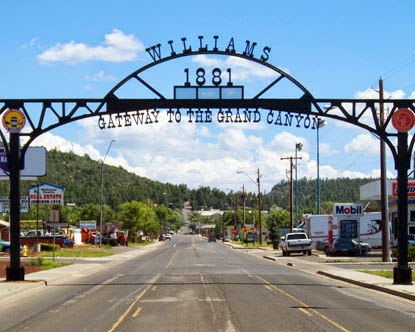
there we drove. We stopped in historic Williams for dinner, and decided to
forgo a joint called Pancho McGillicuddy’s (Mexican Irish food) for a very
mediocre place. Stopped periodically since Ross was feeling ill, including at a
Navajo casino. After this was more driving, on to the last town before Grand
Canyon Village, staying at the Canyon Plaza Resort.
Williams, AZ
Day
Fourteen
Got
up and headed to the Grand Canyon somewhat early after breakfast at the Resort.
After the usual Visitor’s Center purchasing of the totems we walked up to the South
Rim – magnificent beyond word. We walked along the rim until we reached the
Geology Museum, and then began taking the shuttles, namely the Blue shuttle to
food first (a rather late lunch around 3 at Angel. Nearby were historic
buildings, lodges, studios, and other nifty things.) and then the Red Shuttle out
to the end of the line – Hermit’s Rest – stopping at most of the overlooks
along the way. Glimpses of the Colorado River below bely the true size –
something that looks like a nickel actually encompassing the width of three
football fields. On the way back we got sunset pictures before driving back in
the dark to the Resort for a thoroughly mediocre dinner.
Grand Canyon
Day
Fifteen
Woke
up, got out of bed… and drove out of town. We made tracks towards Las Vegas,
specifically the airport, to drop off mom. Stopped for brunch at bizarre, classic Route 66 diner. From the Grand Canyon this
took a pretty long time, not getting there until after 3. After fond farewells
we hit a grocery store on the outskirts of Vegas and stocked up for the desert.
The two of us ended up getting into Death Valley rather late – after the ranger’s
station had closed, and set up tent right as night began to fall. Having picked
a tent site six months in advance, ours had shade, which would prove welcome.
An attempt by Jess to do night photography with her camera (and my tripod)
proved to no avail.
The Snowcap Diner in AZ
Day
Sixteen
Saw
most of what was easily accessible by car in Death Valley. Our campsite was
near Furnace Creek, and so we drove out to the lowest elevation spot in North
America, wandered salt flats, stalked pupfish, and looked at dunes. We decided
to take a siesta back at the tent. The night before we’d put up the rainfly
(due to proximate coyote howling) but it was actually quite pleasant when off.
Siesta over we took to the Furnace Creek resort for showers (at their pool) and
then got some sunset shots. Another night
of camp food (mmm sardines on bagels – Jess felt blegch) and an early sleep.
Death Valley
Day
Seventeen
We
drove, each taking a four hour shift, from our camp site to Pacifica. The first
shift got us as far as Bakersfield and included some rather unsettling shuddery
brakes on a windy road with a steep grade. Driving out of Death Valley was
really quite beautiful – perhaps more so than the eastern part of the park. Up
Highway 5 we got in before the traffic, did a big switcheroo of cars and
belongings in Pacifica at dad’s house (who had been keeping Ross’ car), got
word that mom arrived safely back in Boston, and we all eventually got home to
our respective dwellings. 4,700 miles later.