Tuesday, September 24, 2019

Nobel Literature Rankings

The first work by a Nobel Laureate I read was in 3rd grade: Rudyard Kipling’s Just-So Stories. The next were, from grade school, in 7th grade, William Golding’s Lord of the Flies, and in 8th grade Herman Hesse’s Siddhartha. Afterwards, in Freshman year Lit, I read short stories by Hemingway, Marquez, and Faulkner. Sophomore year brought me Par Lagerkvist, George Bernard Shaw, and Albert Camus, and a new interest in classic literature. By the end of high school the list included Sartre and Solzhenitsyn. But In college I was so busy with the "Western Canon" I only encountered (for school) one new Nobel voice: Bertrand Russell. In my own time, though, I read a couple more, never assigned to me: Steinbeck, O’Neill, and Eliot. I also listened to Bob Dylan.

Upon leaving grad school, however, my familiarity with the Laureates was relatively minor, if still better than most: I’d read 16 authors (including Dylan).

That number is now 95. When the 2019 winners are announced, I will post my updated list of read works.

It is an important year for the Nobel Prize for Literature. After going off the rails in 2018 they are returning with two new laureates, for both the past and current years. Since I began a dedicated course of reading the winners, around 2011 or 2012, I’ve been able to categorize them into the following, remarkably subjective, groups:

No Memory,
Vague Memory,
Average,
Good, and
Amazing

So let’s see how they fare:

No Memory

Aleixandre
Benavente
Bergson
Bjornson
Brodsky
Carducci
Echegaray
Eucken
Jensen
E. Johnson
Karlfeldt
Milosz
Perse
Prudhomme
Quasimodo
Reymont
Seferis
Seifert
Syzmborska
Von Heidenstam
Von Heyse

You are easily forgiven if you don’t know these obscure European authors (many poets, many Scandinavian). This group is heavy on the early winners of the prize, when the award was given for ‘idealism’ rather than innovation or influence. As such - not being influential or innovative - these authors are largely forgotten. I am fortunate, in this regard, to speak English – as that's one of the few languages that's bothered to translate them, and they are otherwise virtually unknown outside their native language. They represent a barrier, and an unpleasant one, to those who would follow me on my journey to read them all: both as a time-sink, and as a linguistic wall. The well-educated woman whose native language is Urdu, say, would likely find it impossible to complete the Nobel list – due to these largely forgotten, and totally forgettable, voices.

Vague Memory

Bunin
Cela
Deledda
Elytis
Gide
Gjellerup
Hauptmann
Heaney
Martinson
F. Mistral
G. Mistral
Mommsen
Montale
Naipaul
Sachs
Sienkewicz
Simon
Spitteler
Tagore

If pressed, I could tell you a bit about these authors. Carl Spitteler, for example, wrote pastoral poems about belfries. Hauptmann wrote German plays about the oppressed proletariat. Mommsen wrote Roman history, and Sachs about the Holocaust. Some of these authors were even enjoyable reads: Cela’s novel and Montale’s poetry, for example, I found to be worthwhile when I read them. But all the same, they weren’t strong enough to provide clear memories – all that’s left are fragments, images, themes, and scenes. You could pick over these, if you want, but what you'll find is a very mixed bag.

Average

Andric
Bellow
Canetti
Coetzee
France
Fo
Gordimer
Hesse
Jelinek
Jimenez
Kenzaburo
Kipling
Lagerlof
Lewis
Maeterlinck
Martin Du Gard
Mo
O’Neill
Pirandello
Rolland
Steinbeck
Yasunari
Yeats

Two types of work fall in this middle set. The first: Totally fine. Probably not a bad use of your reading time. The second: Maybe not so good, but still, for whatever reason, more memorable than the preceding works. Average novels, poems, and plays: Sinclair Lewis’ Main Street, Dario Fo’s Accidental Death of an Anarchist, William Butler Yeats’ The Tower. Some enjoyable (Jimenez’ Platero Y Yo), some not (Rolland’s Jean Christophe) – but not a bad set to start with, if, for some inscrutable reason, you are interested in taking on this burden for yourself, or if you’re just looking for some pretty good books to read to perhaps diversify your literary palette.

Good

Asturias
Churchill
Dylan
Faulkner
Gao
Golding
Hemingway
Ishiguro
Kertesz
Lagerkvist
Laxness
Modiano
Neruda
Pinter
Russell
Shaw
Sillanpaa
Transtromer
Walcott

A really fun category, there are lots of gems here. I think the most enjoyable part of this selection is the mix of well-known and unknown. Few English readers, I suspect, have encountered the Finnish Frans Sillanpaa, but his People in the Summer Night is a tremendous read. So too the French author Patrick Modiano’s novel Missing Person, or Gao Xingjian’s short story collection Buying a Fishing Rod for My Grandfather. And if there are well-known names on here you’ve not tackled yet, this is my endorsement to finally take a crack at the poems of Pablo Neruda, or the novels of William Faulkner. These authors made great strides not likely to be soon forgotten.

Amazing

Alexievich
Beckett
Camus
Eliot
Mahfouz
Marquez
Morrison
Pasternak
Paz
Sartre
Solzhenitsyn
Soyinka

These writers have produced at least one work that is, to my mind, essential – canon. Alexievich’s Voices from Chernobyl. Camus’ The Plague. Mahfouz’ Children of Gebelawi. Morrison’s Beloved. And so on. These are the works likely to stand the test of time, the high-water marks of our global literary output in the past century. If you want to know which were the specific works I read that gave me this feeling, you can see them in my next post, where I will detail my Nobel reading so far, in this upcoming, inordinately suspenseful, Nobel Literature Prize years.

Saturday, September 14, 2019

"Yet Now There Are Only Ten"

So there was a Democratic debate the other night. And, before I go any further, just note that I am a Democrat, and will be happy if any of these candidates beats Donald Trump.

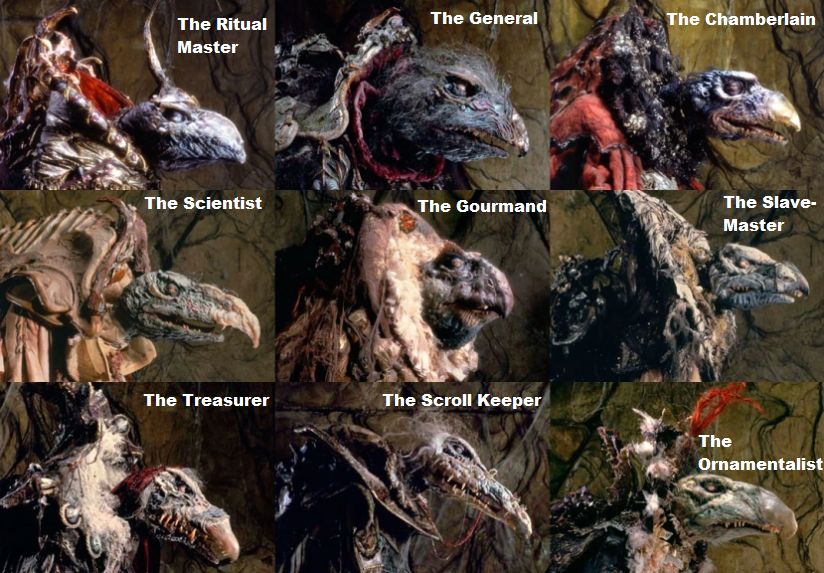
However. Now that we're down to ten front-runners, something in my mind said, "Hey. You just watched the Dark Crystal series on Netflix and are clearly a disturbed person. Why not match the candidates to the Skeksis?"

So I did. You're welcome.

The choices are based on the ten Skeksis of the movie, and assigned based on last night's debate. Here's a handy visual guide for remembering them:


And of course, the nightmare-fuel:


Let's start there:

The Emperor. Bernie Sanders.

With his death-rattle voice it was ever more clear that Sanders is the mighty fallen. Actually, I am hoping that his decrepitude put the fear in his supporters the same way the death of the Emperor scared me as a child. Since he announced I've been worried about giving him any power.

The Chamberlain. Joe Biden.

"Pleeeeeeease: make peace?" Talking about Ohio and trying to get everyone to get along, if Biden gets into the White House he may be as ineffectual as Obama was in squandering a super majority. Half-measures, like his healthcare or his defense of working with segregationists, remind one of the wheedling, unpleasant, Chamberlain.

The General. Kamala Harris.

Harris hasn't found her voice yet, which is bothering folks, it seems. In the first debate she was personal, the second on the offensive, and the third, this past week, trying to lighten up and tell jokes. These shifts are reminiscent of the General, who can go from ecstatic to wrathful in moments. But serious business.

The Scientist. Elizabeth Warren

The most clever of the Skeksis, the one who actually gets things done, the one who can summon strength from the Crystal but who the others, unaccountably, consider weak. She has the same aspect of frustration with her plans that the Scientist shares, in having to get results for a bunch of undeserving...

The Ritual Master. Julian Castro.

Someone said that Castro was built in a lab to be a Vice President. The Ritual Master has a certain gravitas and presence, and he stands out among the Skeksis, as Castro stands out on stage, but the power, like the Vice Presidency, is more shadow and illusion than real.

The Gourmand. Cory Booker.

Since Booker was the only candidate who got a question about food (his vegan lifestyle) during the debate, it seems appropriate that he be the Gourmand - even if he is the physical antithesis of the corpulent Skeksis.

The Scroll Keeper. Beto O'Rourke.

O'Rourke got some needed coverage for his campaign, due to the deference of his rivals after the response to the El Paso shooting. The Scroll Keeper fits, then, because he doesn't do a lot, or really have much of a purpose, but he stands out in the field of Skeksis all the same. Last night Beto stood out, although I doubt his campaign has much of a future.

The Ornamentalist. Pete Buttigieg.

The most youthful-looking of the Skeksis, and not otherwise particularly memorable. I don't think the Ornamentalist has hardly any lines in the movie, nor did Buttigieg.

The Treasurer. Andrew Yang.

From some old source material: "the Treasurer counted gifts, not time." He is also described as having difficulty communicating, which certainly fits Yang. I doubt he has much time left.

The Slave Master. Amy Klobuchar.

I do not like Klobuchar, and so she fits, for me, the description of the least well-known of the Skeksis, the Slave Master, who "remains evilly silent most of the time, except for occasional sneers and hisses." Klobuchar, of course, is not actual *evil* - none of the candidates are. She would be a far superior President to Trump. But she's my least favorite.

Thursday, August 29, 2019

Ten Years Since Grad School

So I got my MAT degree in 2009. One of the best gifts I got when I graduated was from my sister: Tom Moon's 1,000 Recordings to Hear Before You Die. When I got it I'd listened to about 250 of the recordings. A decade later, and I am quite close to finishing the list. Indeed, at this point, I only have 31 left to listen to.

Why post now, and not once I'd finished the list? Well, one reason is the ten-year mark. But, also, there's a lot of context needed for these last recordings. In ten years I lived in Boston, Berkeley, Connecticut, Monterey, Pacifica, Reno, Singapore, and Vallejo. In each of these places I scoured their libraries. When I moved, I always got a library card and raided their CDs. I even scoured the music resources of the UC Berkeley Library, for some of the rather rare tracks. For years I've been going on YouTube, periodically checking as increasingly rare albums were eventually uploaded. 31 recordings, despite all that, have eluded me.

These last 31 recordings are real bastards. They are not *impossible* to find - but they clearly aren't easy, either. Consider a Hungarian artist Moon recommends, whose album was released as a cassette in the 1980s. That shit is not accessible (luckily it has, quite recently, been released in a digital format).

Long story short: since the last ones will probably still take a while to eventually track down, I'm posting now.

Breakdown of my findings: I generally agree with Moon's list. I enjoyed 666 out of 969 recordings, or 68%. Which I think is rather good.

Even with 31 still missing, I still completed a few categories:

Out of 46 recordings labelled 'Blues' I liked 29, 63%.
Out of 43 recordings labelled 'Vocals' I only liked 21, 48%.
Out of 37 recordings labelled 'Folk' I liked 25, 67%.
Out of 32 recordings labelled 'Hip Hop' I liked 22, 68%.
Out of 25 recordings labelled as 'Pop' I liked 13, 52%.
Out of 17 recordings labelled 'Electronica'  I liked 15, 88%.
Out of 15 recording labelled 'Musicals' I liked 9, 60%.

So for most, a majority. I suppose this tells you more about my tastes than anything. But in all I've found it to be a very rewarding experience, and I'm still excited for polishing it off.

Wednesday, July 10, 2019

15 Books to Help You Understand Now

To understand our current era requires a certain breadth, as everything around us seems increasingly interconnected. But, in a world of dizzying change and ever-faster news cycles, what sources can you turn to to get your bearings? Whileit's possible to fashion a list of 100 such critical titles, and there are a *great* many classics that were left off such a condensation, I picked the following works based on having 1) actually read them, and 2) an emphasis on univerals over particulars. What I mean by the latter is, that when trapped in a whirlwind, as tempting as it is to focus on an individual piece of debris, you're better off by understanding the mechanics and laws of the overall cyclone itself. Universal books try to explain the big, background ideas, themes, and developments of our world, instead of getting bogged down in minutiae of the hot new thing of the moment. Those sorts of books are the ones I chose, (The value of teaching a man a pattern versus teaching a man to recognize patterns, to adapt the old fishy saying.)

As such, here are 15 books to help you take stock of where we are now.


Politics


These Truths - Jill Lepore, 2018

Lepore's massive work traces how America ended up in this political moment: the post-2016 American political state. She focuses on the political history, rather than cultural, military, economic, or other such - which is why I categorize it as a political work instead of a history of the United States. If you're scratching your head wondering why all this Trump, alt-right, Fox News, abortion v. guns stuff came to be, then this work will answer your questions.

Physics 


A Brief History of Time: Updated Edition - Stephen Hawking, 2017

Hawking is peculiar, since, as his book points out, he was often wrong about his biggest ideas. Really, the physicist who bested him time and again, is Kip Thorne, so why not read his book? Hawking's work remains the classic, then, because it remains the best description of our current understanding of cosmological physics. The updated version is a must, for both taking into account the discoveries of the past few years, and admitting and explaining his previous errors. His unanswered questions will be the forefront of the next quarter-century.


Economics


Capital in the 21st Century - Thomas Piketty, 2013


It's been a while since anyone tried to create an economics tome this ambitious. In a way Piketty's work may simply serve as a shot across the bow - whether it will become forgotten in a generation, or required reading, remains yet to be seen. The purpose of the work, though, is to try and explain how wealth inequality - the greatest economic challenge of our time - came to be, and what steps could be taken to reign it in.

Technology


Connections - James Burke, 2007

Technology is overwhelming in our world - easier than ever to use (give a toddler an iPad for proof) but we don't really fathom how any of it works. And the digitization and proliferation of screens in the past half century having become synonymous with 'technology' is a problem in of itself. In Connections Burke shows how technology drives change, and teases out the fascinating stories of how we got here, trapped in the bewildering array of devices and technological gizmos which keep us alive, and which we are helpless to try and understand.

Biology 


Endless Forms Most Beautiful - Sean B. Carroll, 2005

While the most exciting developments, these days, are in genetics, there is a broader background story happening in Biology. Evolutionary Biology and Developmental Biology are starting to synthesize - creating 'evo devo'. If that sounds like too much jargon already, no worries - Carroll guides you through it all easily, and explains how genetics is fitting into the singular world of both evolution and embryology.

Poetry 


The Great Enigma - Tomas Transtromer, 2004

Transtromer was a deserving Nobel Laureate for his universally-approachable works found in this collection. There's plenty to love here, whether you are wary of poetry or got your doctorate in the field. Consider one of his last poems, translated by Robin Fulton:

Snow Is Falling

The funerals keep coming
more and more of them
like the traffic signs
as we approach a city.

Thousands of people gazing
in the land of long shadows.

A bridge builds itself
slowly
straight out in space.

Childhood 


Three Seductive Ideas - Jerome Kagan, 2000

We spend about a quarter of our lives as children, and of course spend even more time trying to understand them if we become parents, or work with them as adults. Kagan's book is an excellent work on the field of developmental psychology, and the risks we have as a society of chasing the newest study, which so often gets debunked only much later. The three ideas he tackles were all phonies, but, two decades later, people are still chasing the notions of infant determinism, pleasure-seeking behaviorism, and whether temperament changes over time.

Social Science 


Guns, Germs, and Steel - Jared Diamond, 1997

In case you've not taken AP World History, or been in college, since 1997, Diamond's work is the most important piece of writing in the Social Sciences in decades. From an anthropological perspective, Guns Germs and Steel looks at the role of geography in trade of ideas and agriculture, as well as the three key forces that had the Eurasians dominate the global South. Clear, well-written, and essential.

History 


Voices from Chernobyl - Svetlana Alexievich, 1997

Prior to her win in 2015, no historian had gotten the Nobel prize for writing history in decades. But that's perhaps because Alexievich's prose did something new for the field. Ironically I made this list even before HBO's hit show 'Chernobyl', based on this book, brought her to more prominent attention. Voices is one of the best works of history I've ever read, and destined to remain a classic.

Novel 


Beloved - Toni Morrison, 1987

Novels haven't changed much since the advent of the post-modern form. After the heyday of experimentation of the late 18- to mid-1900s, prose has been fairly dormant, regarding innovations. All the same, some virtuoso voices have come forth, and Nobel Laureate Morrison's most famous work, Beloved, is as powerful now as it was thirty years ago. Taking advantage of the magical realism that originated in Latin literature, the novel stakes out important territory regarding race in America.

Chemistry 


The Periodic Table - Primo Levi, 1975

Chemistry is hard to get into. It can be difficult to visualize the chemical reactions that are surrounding us and the millions of chemical combinations we experience daily. Levi's remarkable work, deemed one of the greatest pieces of nonfiction of the 20th century (the Royal Institute named it the best science book. ever.), allows us to see the world through a chemist's eyes, explaining, via memoir, fiction, and a bit of science, to understand the world chemically. If you only read three books on this list, make this one of them.

Art 


Ways of Seeing - John Berger, 1973

The now-classic work was, fittingly, based on a television series. Personally, I strongly prefer Berger's 'About Looking' (1980), but Ways of Seeing was a landmark and remains a good book to read if reading books about art makes you queasy. The focus is on how we see art, and what, of course, counts - referring to things like advertising and creating important distinctions that have value today in a world that is still mass media-driven.

Environment 


Silent Spring - Rachel Carson, 1962

Why not pick something more recent, more timely? Something that specifically deals with our existential threat of climate change? Because, at its heart, humanity's interaction with the environment was fundamentally altered with this book. DDT may no longer be a scourge, but most of the book doesn't deal with those specifics, instead fleshing out a view of the environment that we take for granted today - including our role in affecting it. 

Drama 


Waiting for Godot - Samuel Beckett, 1953

Interesting, isn't it, how drama hasn't shifted all that significantly since Godot's debut over 65 years ago. There have been dramatic masterpieces since then, of course (Angels in America by Tony Kushner comes to mind). But for a remarkable on-the-page experience, Godot continues to deliver as the greatest dramatic work since Modernism began defying both prose and theatrical conventions nearly a century ago. 

Philosophy 


The Second Sex, Simone de Beauvoir, 1949

Most dated on the list, but it remains one of the most important. De Beauvoir's partner, Jean-Paul Sartre, wrote one of the defining tomes of existentialism, Being and Nothingness. And that book's still eminently readable and important - but in strict philosophical terms, increasingly outdated. Indeed, for current philosophical trends, angling towards language, Ludwig Wittgenstein's Philosophical Investigations should, by rights, be the obvious choice for this list. But de Beauvoir's landmark second-wave feminist text has more to offer, I think, than either of those volumes, and is far more prescient in achieving the goal of understanding now: all the more surprising, perhaps, when regarding the role of women in our society today compared to our perceptions of their lives in the 1940s. Lengthy, and at times challenging, admittedly parts haven't aged super well, but very rewarding for the dedicated reader.

Thursday, July 4, 2019

Two Education Mini-Posts

Here’s a mix of silliness and profundity: Immanuel Kant and View-Masters are my favorite analogies for education.

Kant was the phenomenological philosopher of the 1700s. View-Masters are those little thingies you hold up to your eyes and click through a wheel of slides to see different images.

They are related in my mind because Kant said we can’t help but see the world through the “lenses of space and time” – they are irremovable goggles. His (vastly oversimplified) model is of a single way to see the world. Contrast that idea with a View-Master model – where that you can ‘flip’ through different ways of seeing – that is my model of a good education. A poor education leaves you like Kant – with a single way of seeing the world. A good education allows you to change your view as you wish.

An example of this central idea I guide students through, of different ways of seeing, is the farmer’s market. The biologist walking down the street would probably notice particular things: the displays of cultivated fruits and vegetables, the trees lining the sidewalks, the invasive pigeons. An economist, however, would be aware of a totally different market: the setting of prices, the haggling, the effects of abundance and scarcity, the competition of the egg vendors. Still again, the photographer while winding through the crowds is looking at light, angles, potential subjects, and strong contrasts.

Each experiences the farmer’s market in a different way. An education should, ideally, allow one to flip through these ways of seeing at will. The educated person should have the choice to walk through the market however they choose.

The world has specialists – rare, talented, students with an outstanding gift in dance or math, poetry or programming. The kids who can’t take off the goggles of the scientist or the painter. We, as a society, all benefit from those schools that nurture those unique gifts. For the rest of us mere mortals, though, a well-rounded model is best. How come?

Some argue education is to get you ready for the workforce, but this is not very persuasive. With the current rate of change, a large number of students will work in fields that don’t yet exist. The original education system was developed in the industrial revolution – and the goal was, indeed, to ensure a workforce that could handle the factory system. But, nowadays, as technologies progress, every field has had to adapt. Whether you want to be a journalist or a musician, the role of technology in just the past five years has radically altered your world: so, can we really say education is to get job training?

Exploring your passions is another reason for education, some say. There is some truth to this – if your passion is part of school. Alas, as many of my middle school students will lament, Fortnite and Karate are not part of the curriculum. If your passion is basketball, American History, or writing stories, school is great. But we are fooling ourselves if we think that schools cater to all passions. We do our best, allowing students to explore their passions through clubs, electives, and extra-curriculars – but must admit, due to limitations, that school serves a different function.

No, the best reason to develop well-rounded people, students who have the View-Master of vision instead of the Kantian irremovable goggles, is because we all live in this world together. We share a society, and are fortunate enough to have a say in that society. When you go to the polling place, or to the gym, the coffee hour at church, or the office party, we all do well to see the world through the eyes of others. To be able to make decisions that are open-, rather than narrow-, minded. To consider the effects of a policy, or a law, from all the angles we are capable of. We educate, in short, so that our children see the world through as many pairs of eyes, and “ways of seeing”, as possible. Armed with this pluralism of vision, our students will be able to take on everything the future holds, far better than if limited to a single viewpoint, or simple set of skills.

*     *     *

When living in Singapore I gave a repeated lecture, in different areas around the island. The topic was on how to teach History – of interest to me, since I am a History teacher. It opened, after pleasantries, with the following:

“History is unique in the global curriculum. Most classes you take teach you how to do the subject they profess – the subject in the title of the course. In a Science class you do science. You complete lab work, write lab reports, formulate hypotheses: in a word, scientific research. In literature courses you learn how to write fiction, write criticisms, analyze texts, and gain some familiarity with the classics.

“History doesn't do this, and is unique for it. No professional historian sits around memorizing facts. Not a one. The only poor souls who have to do that are history teachers. In the US I teach World History. This is a course that covers everything – everything worth knowing apparently – between Australopithecus and the Renaissance. No joke.”

My Singaporean audience was often startled and amused by this notion. The lecture continued:

“Why is this useful?

“The predominant argument comes from E.D. Hirsch, the main name behind cultural literacy. Basically, if you and I share a cultural background, we can communicate through cultural shorthand. An example: You are feeling guilty about treating someone badly. To convey that I'm aware of your distress, I can look at you and say, in a certain reproachful but leading tone, ‘Out, damned spot!’ If you know Macbeth it makes sense. If you don't, it doesn't. We use this shorthand all the time: A Faustian bargain, his Achilles heel. Of course, it's not just literary: movies, comics, music: nearly all media is part of our shared cultural literacy.

“The problem is, since cultures are geographically bound, so, too, are historical events part of this literacy. If you live in America there are certain historical names, events, and places of significance: the Alamo, Graceland, Gettysburg, Franklin, the 49ers.

“This is what history classes teach, the world over. Only, now that the world is globalized, it has become necessary to not only know your own stuff, but everyone else's, as well. Now that I'm in Singapore what do I teach? The Cold War. Because they need to know about McCarthyism, Stalin, and the Brandenburg Gate. That's not fatuous – they really do need to know.”

At this point in the lecture I gave a quick history of History (how meta!) which is, perhaps surprisingly, a very young field of study. You could get a University degree in North Africa in theology in the 900s, or a medical degree in Italy by 1300. Oxford’s been handing out law degrees for a millennium. But American schools didn’t recognize History majors until the Civil War era.

So, what do these Historians do, if not sit around memorizing facts? From the lecture:

“On my American syllabus – it doesn't matter for which course – I begin with a simple statement: ‘History is about questions, not facts.’ Facts help us answer questions, but the same facts can be manipulated to serve opposing interests. (Entering WWI all the countries had the same facts, but each came up with histories, influenced by Nationalism, that ‘proved’ that they were the superior country.)

“What instead of memorizing facts, should historians do? Historians, professionally, try and answer questions about the past. They need facts to do this, of course, but it is the questions that motivate them, and drive their work. But how often do we let students devise their own history questions?

“If we were to get students together in a room and say: ‘This is a class on The Cold War. Each of you brainstorm your individual research projects, and I'll discuss them with you. In three weeks expect to present what you've written.’ Now we've gained what historians actually do, and if history is to be taught like other classes, this is what it would have to look like. But the flip side is we've lost what the classes currently provide: cultural literacy. Do we want students walking around who don't know what Gettysburg or 1776 is? No.”

The lecture’s conclusion was that the most radical approach was to teach History would be neither as cultural literacy, nor mirroring the professional actions of historians:

“Maybe research methodology isn't the ideal classroom. I propose that history isn't about questions, but is instead, not a discipline at all. It could be that history is a mental tool, like logic or scientific method. Merely a tool for making sense of things. You can apply history to anything, just as you could apply logic or scientific experimentation: some things it will work well on, others it won't. It won't work on everything: just as a wrench won't help when you need a screwdriver. When applied to the proper field, it can lend new insight. Art history is an example – by studying pieces of art, in sequence, we can reach a new understanding on what art is.

“Maybe, then, we can just teach this historical mindset. Maybe, like logic, we can teach how historians see and make sense of the world, and have students then apply history to different subjects, such as math, literature, and science. But maybe that’s more of a dream, I suppose, than a move to teach historical research methods.”

A few final pleasantries and recap, and the TED-talk-style lecture was over.

Saturday, June 15, 2019

America's Palme D'Or Winners

So I realized a little while ago that I'd seen many, but not all, of the American films to win the Palme D'Or: the prestigious, international award for Best Film.

As such, I went ahead and watched the ones I'd not seen, and have now ranked them, for your convenience.

American Winners

A/A+  The top caliber of film - should be viewed by most people on the planet:

Taxi Driver (1976). Dir. Martin Scorsese. A shocking tale of New York, from the perspective of a sociopath Robert De Niro.

Apocalypse Now (1979). Dir. Francis Ford Coppola. One of the great war films, a tour de force of cinematography, and outstanding acting by Martin Sheen and Marlon Brando.

Pulp Fiction (1994). Dir. Quentin Tarantino. The atypical narrative structure, the all-star cast giving their best work, the remarkable dialogue and visuals all coalesce into a great vision of 70s gangsters.

A- An otherwise excellent, but slightly flawed, film:

All That Jazz (1980). Dir. Bob Fosse. Visually mesmerizing, autobiographical, account of Bob Fosse's career, starring Roy Scheider.

Fahrenheit 9/11 (2004). Dir. Michel Moore. A documentary (?) about the Iraq War and the Bush years, which has held up pretty well, and is still important viewing, if not Moore's strongest.

B+ A film that you should definitely see, regardless of small flaws:

The Lost Weekend (1946). Dir. Billy Wilder. A sobering, ruthless portrait of an alcoholic's fight with addiction.

B A memorable film probably worth your time:

Barton Fink (1991). Dir. Joel and Ethan Coen. John Turturro and John Goodman give nice performances in a Kafkaesque vision of early Hollywood.

B- An otherwise good film, with some notable flaws:

Sex, Lies, and Videotape (1989). Dir. Steven Soderbergh. An interesting indie classic about the intersection of sex and video, but the lead actor doesn't quite pull off his performance.

C+ A bit better than the average film, not a bad use of viewing time:

Friendly Persuasion (1957). Dir. William Wyler. A truly odd concept: A telling of the Civil War from the perspective of Quakers, starring Gary Cooper.

C An average film with nothing particular to recommend it:

Marty (1955). Dir. Delbert Mann. The story is that Ernest Borgnine wants love, but is homely.

Elephant (2003). Dir. Gus Van Sant. A long, meditative, slow-paced reflection on Columbine.

C- Not quite as good as an average film, potentially worth a watch, with conditions:

MASH (1970). Dir. Robert Altman. A comedy about the Vietnam Korean War from the perspective of some goofy, rule-breaking, scamps.

The Conversation (1974). Dir. Francis Ford Coppola. A whodunit focused on bugging and recording, which, despite the San Francisco locale, is not particularly entertaining.

D+ Not a good film, but may have one or two slight redeeming aspects:

Scarecrow (1973). Dir. Jerry Schatzberg. Take 'Midnight Cowboy' and put it on the road with Al Pacino for Dustin Hoffman, and Gene Hackman as himself.

Wild at Heart (1990). Dir. David Lynch. A vaguely compelling train-wreck of a film, starring a Nicholas Cage and Laura Dern as young lovers trying to escape Dern's violent mother.

D An entirely forgettable, unpleasant to watch film:

Union Pacific (1939). Dir. Cecil B. DeMille. A boring film about the 1876 railroad.

D- A very unpleasant film:

The Tree of Life (2011). Dir. Terrence Malick. I hate most all of Malick's work. Pointless, cinematographic wanking-off, with a dumb plot, and bad acting.

F Unwatchable:

The Tragedy of Othello: The Moor of Venice (1952). Dir. Orson Welles. Despite the attempts at camera work, the flatness is truly unwatchable - not to mention Welles' blackface as the moor.

Monday, May 20, 2019

American Congressional Academy Update


Back in 2016 I proposed an American Academy - modeled somewhat along French lines. Since then, some of the luminaries have died, notably I.M. Pei. Another, Neil DeGrasse Tyson, has been credibly accused of sexual misconduct, and until such a time as his name is cleared, I'm replacing him with the great Kip Thorne. Another, Sandra Day O'Connor, has retired from all public positions.

And so I have updated the positions, below, along with their ages while I was at it. A few new seats have also been added, upon further reflections. Another new feature is the name listed, italicized, of the memorial dedication of the chair. For example, Seat 1 would be the "Jonas Salk Memorial Seat for Medicine".

American Congressional Academy

Membership requirements: 1) American Citizen and adult resident for at least 10 years. 2) Significant innovation or influence in the field. 3) Not currently serving in the United States Legislature, Judiciary, or Executive branches of government in an elected position. 4) Must be able to attend the three annual meetings in person.

Foreign membership requirements: 1) Significant innovation or influence in the field, of global recognition. 2) Must be able to attend at least one of the three annual meetings in person.

Purpose: To make an annual report to Congress and the public of the areas in which the United States should direct its energies, financial, intellectual, and professional, with a focus on problem-solving.

Organization: The Academy consists of thirty permanent Seats, each representing a different facet of American life. One individual serves as Secretary General, whose position must also reflect a significant contribution to the field of Activism. All of the Academy Membership requirements apply to the Secretary General. The Seats, initially filled by Congress, are lifetime appointments, allowing for an Academy Member to resign at any time, with possibility of reappointment. Seats are appointed by a 2/3 majority of the sitting Academy Members. The Secretary General is also appointed by 2/3 majority of the Academy Members. In addition, five International Seats will also be appointed by the Academy Members, by 2/3 majority. Being an International Member provides the same contribution privileges, however they do not vote on new membership of any type except Secretary General. As with Academy Membership, International Members are lifetime appointments, but may resign with possibility of reappointment. The Secretary General may be recalled from the post by a 2/3 majority vote of the entire Membership, consisting of both the Academy and International Seats. If recalled, the individual may be appointed to a vacant Seat, if they fulfill the facet represented, or later reappointed as Secretary General, or Academy Member. A memorial designation may also be re-designated by a simple majority vote, not including International Members. The new memorial designation must have equaled or exceeded the stature and influence in the field of the previous title holder.

Inaugural 2016 Academy Membership:

Seat 1, Health (Jonas Salk): Louis Wade Sullivan, 85

Seat 2, Physics (Josiah Gibbs): Steven Weinberg, 86

Seat 3, Prose (Mark Twain): Toni Morrison, 88

Seat 4, Mathematics (John von Neumann): Persi Diaconis, 74

Seat 5, Poetry (Emily Dickinson): Lawrence Ferlinghetti, 100

Seat 6, Chemistry (Linus Pauling): EJ Corey, 90

Seat 7, Law (James Madison): Audrey B. Collins, 73

Seat 8, Education (Booker T. Washington): Sal Khan, 42

Seat 9, Technology (Benjamin Franklin): Elon Musk, 47

Seat 10, Music (Bessie Smith): Wayne Shorter, 85

Seat 11, History (WEB DuBois): David McCullough, 85

Seat 12, Architecture (Frank Lloyd Wright): Frank Gehry, 90

Seat 13, Journalism (Ida B. Wells): Gloria Steinem, 85

Seat 14, Human Rights (Frederick Douglass): Dolores Huerta, 89

Seat 15, Economics (John Kenneth Galbraith): Amory Lovins, 71

Seat 16, Anthropology and Sociology (Franz Boas): Jared Diamond, 81

Seat 17, Astronomy and Cosmology (Edwin Hubble): Kip Thorne, 78

Seat 18, Biology (Rachel Carson): E.O. Wilson, 89

Seat 19, Design (Muriel Cooper): Paula Scher, 70

Seat 20: Philosophy (Thomas Dewey): Saul Kripke, 78

Seat 21, Two-Dimensional Art (Georgia O’Keefe): Kara Walker, 49

Seat 22, Three-Dimensional Art (Alexander Calder): Maya Lin, 59

Seat 23, Psychology (William James): Elizabeth Loftus, 74

Seat 24, Theater Art (Paul Robeson): Lin-Manuel Miranda, 39

Seat 25, Film and Television (Thomas Edison): Spike Lee, 62

Seat 26, Labor and Business (Walter Reuther): Bill Gates, 63

Seat 27, Theology (Paul Tillich): Pema Chodron, 82

Seat 28, Military and Intelligence (George Washington): Michael Mullen, 72

Seat 29, Politics (Abraham Lincoln): Barrack Obama, 57

Seat 30, Secretary General - Activism (Martin Luther King): Angela Davis, 75

Inaugural 2016 International Members:

Art (Frida Kahlo): Ai Weiwei, 61, China

Science (Charles Darwin): Jane Goodall, 85, United Kingdom

Social Science (Antenor Firmin): Muhammad Yunus, 78, Bangladesh

Politics (Sun Yat-Sen): Ellen Johnson Sirleaf, 80, Liberia

Law and Journalism (Nelson Mandela): Tawakkol Karman, 40, Yemen