Tuesday, November 3, 2015

Presidents' Rankings - Top Ten


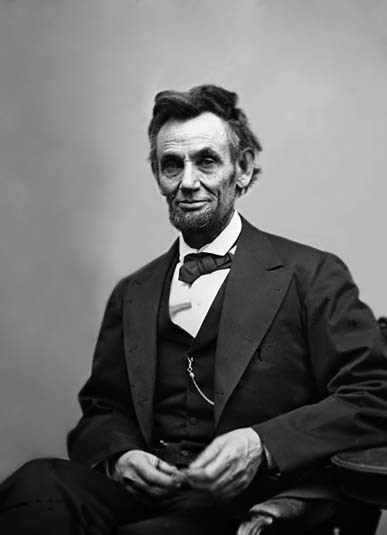
01. Abraham Lincoln, 1861-1865. Republican. Known for: Gettysburg Address.

Presidential Legacy: Leadership during the Civil War, Emancipation Proclamation and 13th Amendment ending slavery, Reconciliation, Assassination. Made Thanksgiving a holiday.

I mean, come on - Lincoln had to keep this nation from ripping itself apart. He freed the slaves and reconciled the Union and Confederacy and began planning Reconstruction.
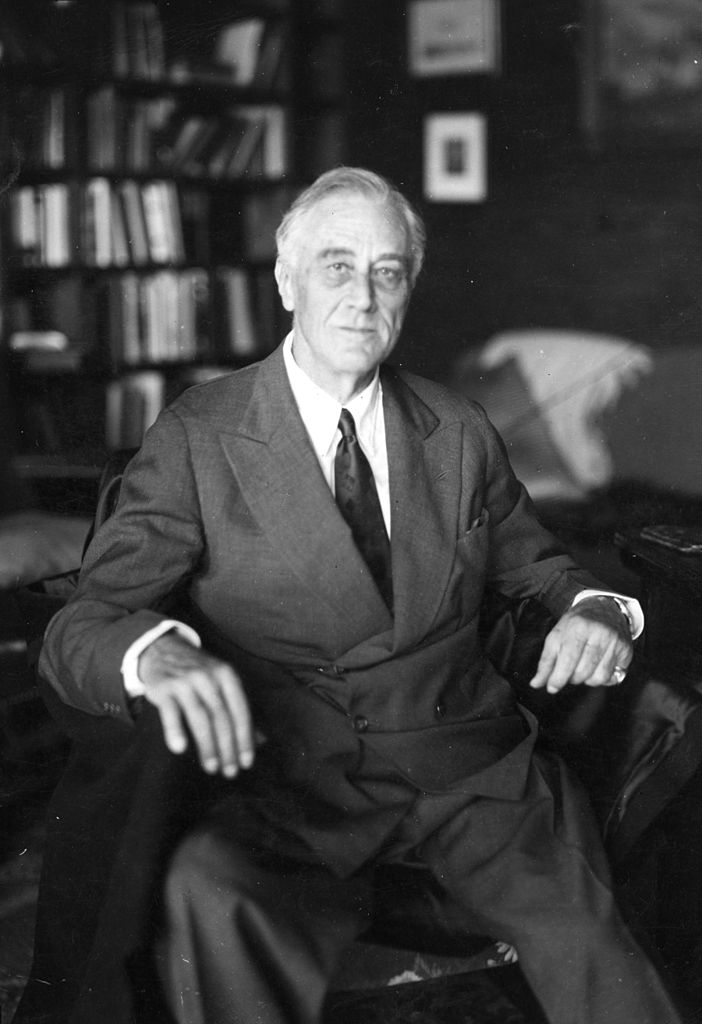

02. Franklin Delano Roosevelt, 1933-1945. Democrat. Known for: The New Deal

Presidential Legacy: New Deal - Lowered unemployment and raised the GDP while lowering the national debt, WWII intervention and leadership, Internment Camps, Only president elected to four terms.

Besides the Civil War and slavery, surely the Great Depression and World War Two were the two greatest challenges we ever faced. The man didn't even have use of his legs.


03. George Washington, 1789-1797. No Party. Known for: First President.

Presidential Legacy: Set the two term precedent, Invented the idea of a cabinet, Whiskey Rebellion, Jay Treaty reestablishing relations with Great Britain.

He set the tone for the Presidency, showing the Federal Government under the new Constitution wouldn't be a repeat of the Articles of Confederation. And rebuilt the country after the Revolutionary War.
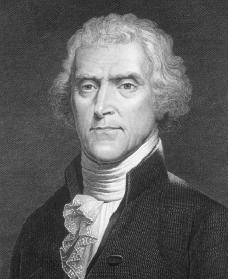


04. Thomas Jefferson, 1801-1809. Democratic-Republican. Known for: Louisiana Purchase.

Presidential Legacy: Barbary Coast War - America's first conflict, Lewis and Clark Expedition, Assimilation policy for Native Americans and Tecumseh's War.

By doubling the size of the country, Jefferson transformed the US into a continental power. He also had to deal with America's first big conspiracy with Wilkinson and Burr.
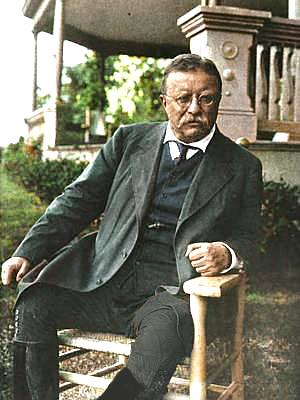

05. Theodore Roosevelt, 1901-1909. Republican. Known for: Panama Canal.

Presidential Legacy: Trust busting, Pure Food and Drugs, Conservation and National Parks, Roosevelt Corollary. First American to win a Nobel Peace Prize for arbitrating the Russo-Japanese War.

The most recent of the Mount Rushmore Gang, Roosevelt defined the Progressive agenda that would define 20 years of American policy. Also lays claim to a number of Presidential 'firsts'.


06. Woodrow Wilson, 1913-1921. Democrat. Known for: League of Nations.

Presidential Legacy: Creation of the Federal Reserve, Approval of racial segregation, WWI intervention, 19th amendment - Women's Suffrage.

Wilson had to get involved in World War One, and afterwards redefined how Western nations viewed war and its aftermath. Unfortunately his stroke meant his Presidency ended on a whimper.


07. Barrack Obama, 2008-present. Democrat. Known for: Obamacare.

Presidential Legacy: LGBT Rights, Handling of the Financial Crisis, Deescalation of Iraq and Afghanistan, Further encroachment of NSA wire-tapping, Bin Laden, Cuba, Prison and drug reform..

Despite the worst Congress in US history, he pushed through a significant Progressive agenda. Inheriting the worst Presidential legacy, and turning it around, was quite the feat.
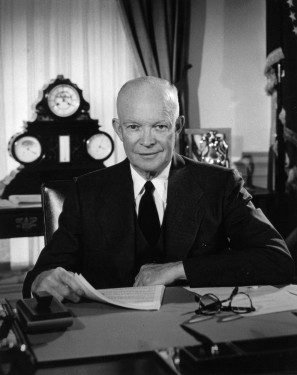

08. Dwight Eisenhower, 1953-1961. Republican. Known for: Golf.

Presidential Legacy: Sent first soldiers to Vietnam, CIA coups overseas, Nuclear stockpiling, Creation of NASA, Interstate highways, Little Rock, Alaska and Hawaii. Liked taxing the wealthy.

The last of the Lincolnian Republicans, Eisenhower saw the Federal government as a way of increasing prosperity - which he did for all Americans. His foreign policy decisions were less ideal(istic).
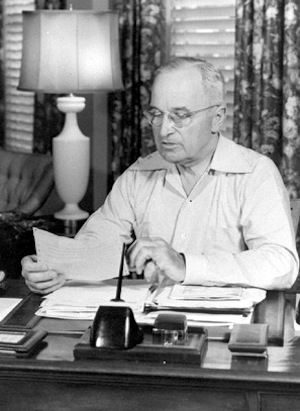

09. Harry Truman, 1945-1953. Democrat. Known for: Hiroshima bombings.

Presidential Legacy: Truman Doctrine - Communist containment, Creation of the US Air Force and CIA, Support of NATO, the UN and Israel, Korean War. After WWII began America's desegregation.

Truman is slowly coming round for historians, as blame for an inevitable Cold War is no longer on his shoulders. Instead he's lauded for rebuilding Western Europe and setting the tone for Civil Rights.


10. (tie) John F. Kennedy, 1961-1963. Democrat. Known for: Assassination.

Presidential Legacy: Bay of Pigs Fiasco, Cuban Missile Crisis, Partial Test Ban Treaty, Escalation in Vietnam, Peace Corps and Civil Rights. His Playboy affairs likely included Marilyn Monroe. 


10. (tie) Lyndon Johnson, 1963-1969. Democrat. Known for: Civil Rights

Presidential Legacy: Reaction to the Free Speech Movement/Counterculture, National Endowments for the Arts and Humanities, Medicare and Medicaid. Overseas he furthered involvement in Vietnam.

The combined Kennedy/Johnson administration has a core of idealism - going to the moon, a Great Society, the Voting Rights Act. But both Presidents had significant drawbacks: escalating Vietnam and being ineffectual. Each of these drawbacks, ironically, is countered by the actions of the other - Johnson was more effectual than Kennedy, and Kennedy wouldn't have heightened Vietnam.

Saturday, October 17, 2015

The Bible II

The Bible II

Genesis II
Chapter 1

After Revelations there was God, Jesus, and the Holy Spirit. Heaven was crowded, and nobody would stop singing.

“We’re going to do this again.”

“Dad, no.”

“I can do better this time. This time I’m not going screw up. Holy Spirit, your thoughts?”

“…”

Chapter 2

And so God created the universe from a vast explosion. Before this there was nothing – neither time nor space. But with this explosion there was time and space, which, it turns out, are the same thing. And His law became the law of the universe, and it really wasn’t that metaphorical. And these laws he dubbed gravity, strong, weak, and electromagnetic.

In the first three minutes, hydrogen and helium protons formed, the base elements which comprise 98% of the universe. But it would take another 377,000 years for them to form actual atoms.

Chapter 3

Around 560 million years after the Big Bang, or more than 13 billion years ago (as of the writing of this text in 2015, which, incidentally, is written by humans, inspired by God, but, to clarify, is subject to change not due to fallibility but due to limited human understanding of the cosmos at this unique juncture in cosmic time) the stars formed.

Chapter 4

“Why are you writing a science textbook of the early universe?”

“Well you have to start with Genesis…”

“I’m with Jesus on this. The humans will need to figure out science on their own. They can’t just be told ‘and then there were atoms.’ It doesn’t have any meaning.”

“Well metaphor is what screwed up everything last time, coupled with a lack of understanding of scientific cause and effect.”

“Just trim it down to the basics.”

Chapter 5

Everything exploded into being. A very long time ago. Because God said so.

Chapter 6

One of the things that came about from the explosion was stars and planets. On God’s favorite planet, the conditions were perfect for life, for God wanted it to be that way. And then, in Africa, people showed up.

Chapter 7

“Showed up?”

“You said to simplify! So here I AM. Simplifying. Gonna skip all the evolution stuff.”

“You can do better, Dad.”

<*omniscient sigh*>

Chapter 7

And God first created life in the form of the unseeable,

Chapter 8

“Unseeable? You’re making up words!”

“That’s My right.’”

Chapter 9

and the small forms grew and combined and copied and transformed and became complex, and beautiful. And life spread across the planet, from barren desert to desolate waste, from forest and dale to the deepest sea. And, after billions of years, one animal life came to be God’s favorite, and this was Man.

Chapter 10

“No.”

“No.”

“What?”

Chapter 11

And, after billions of years, one animal life came to be God’s favorite, and this was Man. Humanity.

Because, to make this very clear from the start, men and women are equals. And they formed tribes and slowly, originating in Africa 200,000 years ago, began to move across the land, to all places that would support their life.

Also there was evil.

Chapter 12

“I don’t know if you’re taking this seriously.”

“Well, I certainly didn’t want to write this thing by committee! It was easier before when it was just me.”

“Technically it still is.”

“Shut up.”

Chapter 13

Fine. So humans did stuff God didn’t like, and they needed to stop that. Like killing each other for no reason. Harming each other. Acting, basically, like animals. The whole reason God loves you humans better than anyone is for your reason. That’s what makes you special and you should really be able to figure out that line of reasoning.

Chapter 14

“Subtle.”

“I’m not so sure…”

Chapter 15

As they left Africa humans encountered other kinds of humans, like Neanderthals. And they learned from them, slept with them, and killed them. Killed them dead. Also: hobbits in Indonesia!

In certain parts of the world the climate and soil was great for farming, and there were animals to be domesticated and really, the humans who ended up in those places basically got a huge leg-up. Sorry to the rest of y’all. ‘Cause they are going to come to where you live and screw you over badly.

Chapter 16

“Listen, we’re trying to avoid the mistakes of last time, right?”

“Yeah.”

“So let’s make sure they’re all equally capable of surviving and don’t go tribal and kill each other when they meet new people.”

“Guys – I can’t. That would mean getting rid of their free will.”

“Like Jesus said – we’re trying to avoid mistakes this time.”

“I can’t get rid of free will! What’s the point? They won’t make bad decisions any more!”

“Right.”

“They won’t be punished!”

“Good.”

“There won’t be any sin!”

“And…?”

“…And you guys just don’t get the point of this. The point of Earth and humans isn’t to watch it tick away like a clock always knowing the next motion. It’s to be surprised by what they’re going to do next! They’ll come up with bizarre ideas and crazy theories, insanely brilliant inventions that have no practical function and artistic masterpieces! They’ll treat each other horrifically and sublimely. Watching it play out is the whole point.”

“Then why do you punish them?”

“To control the experiment! The parameters by which the efficacy is judged.”

“Dad… How many more times are you going to do this?

“As many as it takes.”

“…”

“Let’s put the book away for a while, okay? Maybe pick up with Exodus next time.”

Sunday, October 4, 2015

Halloween Month

So, we start complaining about Christmas being a month long in November, the day after Thanksgiving. (Well, not the day after, of course – then we are too worried about people being trampled to death at Wal*Mart.) But, and this may just be my friend base, October 1st rolls around everyone is getting excited about Halloween.

Now, I’m an atheist, but I don’t really mind the month of Christmas. I like carols, and Victorian Christmas hymns in minor keys, and the general concept of good things in dark times. I like eggnog and Currier and Ives and all that shit.

And I like Halloween.

But, since people in my Millennial bracket are freaking out about Halloween, I’m a little concerned. As a kid it makes total sense why Halloween is so great – you get to break the cardinal rules of childhood. You literally ask strangers for candy. Candy you will eat late at night. After you dress up as a scary thing, and lie about being someone you are not, while threatening the neighbors.

Don’t mistake me – I am well aware that the adult Halloween party is not some new phenomenon. But, are we, like, more into it than before? Even my middle school students aren’t this excited. It used to be something we looked forward to the week of, perhaps. But now it’s a month-long thing. And for adults (I really, really hope) there’s no trick-or-treating involved; unless we’re the ones doling out the candy. It’s really just the dress-up and mood that most folks seem to be intrigued by.

After a few years on the East Coast I get the appeal of a gnarled denuded tree in the Autumn moonlight. There’s something special about that. But is this Halloween love another example of the inability of Millennials to grow up? We still want to dress up and eat candy at 30, and, since that’s still too weird for week-to-week behavior, we freak out and get overly excited when October rolls around? I think it is a Millennial issue.

In 1979 Etan Patz disappeared on the way to school. It was a huge story – there had been child abductions before, but this one broke the national conscience. His face was the first one on a milk carton. The day of his abduction is National Missing Children’s day, May 25.

Six months before, the character of Michael Myers was introduced to the world in Halloween. Throughout the 1980s I think the conflation of Halloween as genuinely dangerous and a concern over unsafe children made for a new cultural climate surrounding the holiday. I mean, in 1985 60% of parents thought their child was at risk from poisoned Halloween candy. These were the over-protective Boomer parents and the earliest Gen X parents, whose own youths could keep a psychology convention occupied for a month. They had such screwed up childhoods, it’s no wonder they freaked out over parenting. And all of a sudden the fun rule-breaking, once a year, for kids to take stranger’s candy and be out late at night, became an area of serious worry and anxiety.

It’s obvious that for the Millennials, whose childhoods were mostly spent in the late 80s and 90s, it was a time of inordinate post-Cold War optimism and triumphalism. Polls indicate that tension surrounding the holiday abated, after a decade of concerns didn’t pan out. We instead grew up with The Nightmare Before Christmas, Hocus Pocus, Casper, and the Addams Family. Things just seemed safer. Halloween wasn’t the scary time it was ten or fifteen years earlier – with fears of poisoned apples and child abductions.

As Millennials grow older, and look back with longing on their childhoods – a generation that fears in its core that its best days are already behind them – Halloween has become a celebration of that better childhood. Our teens were ruined by the Bush era insanity, and the terrorism concerns of a post-9/11 world. Our twenties were devastated by the economic collapse. After 40 years of stupidity and mismanagement Millennials are way behind the Boomers in life accomplishments at the same age.  (Millennials now average around $35,000 a year, according to recent data. In 1978 dollars, that’s around $10,000. And the actual median household income in 1978 was $15,000.)

…Somehow this has something to do with Halloween.

Right, to recap: Millennials are weirdly obsessed with Halloween because the holiday is associated with childhood, and this generation had a particularly blessed childhood, especially in comparison to their teens and twenties. So since literally acting like a child isn’t yet acceptable (but keeps creeping in on the cultural more and more as many have pointed out) we’ve begun to fetishize October as a whole month, but I don’t think we’re culturally cognizant exactly as to why. We all really like Halloween, but few can give a particularly convincing answer, I don’t think, beyond ‘it’s fun’. Why is it so fun?

To answer this, finally, I think the dress-up is a big part of it. Many of us, getting on into an adulthood we are loathe to accept, enjoy the comfort of pretending to be someone we are not. Again, costume parties aren’t something new. In the 1950s adults dressed up on trumped-up pretexts and pretended to be someone else and let their hair down. Masquerade balls go way, way back. I think it comes and goes. Right now it’s approaching a weird high-water mark.

Perhaps it’s not so weird, though, given all the aforementioned. Perhaps Halloween is when we let our imaginations take flight.

This generation is just now feeling the wind pick up, and getting themselves out of the doldrums of a largely wasted decade. The debt and burdens are still there, but we’re coping a little better now than, say, we were from 2009-2012. Perhaps as we enter our thirties properly our Halloween interest will gracefully decline. The nostalgia for our childhoods will dissipate as we recognize that our best days are ahead of us, and not behind.

Or, maybe, we’ll be a bunch of grown-ass adults who eat mac n cheese and watch cartoons. I don’t know.


Anyway. Here we are. It’s October and Halloween month has begun.

Saturday, October 3, 2015

Animals

John Berger is an English academic, who, in 1972, put out a very influential collection of essays,Ways of Seeing. One of his essays that most influenced me is “Why Look at Animals” (you should click the link to read it - it’s great). The essay deals with the distancing of humans from nature, the Iliad and language, anthropomorphism, domestication, capitalism, and why going to zoos makes us sad. And, born in 1926, Berger is still alive. 
I would love to know his views on memes and the roles of animals online. Ever since the net has been a thing, Berger’s books have shied away from it. His main focus, and, to be fair, the main focus of Ways of Seeing, is photography. But his essay on how we view animals is a landmark. In 2009 Penguin Classics chose to include it as their most chronologically recent selection in their 100 Great Ideas series - a list that includes writings by Orwell, Darwin, Confucius, and Plato. It’s worth revisiting, I feel - especially now that, in the 21st century, our interactions with animals are shifting all the more.
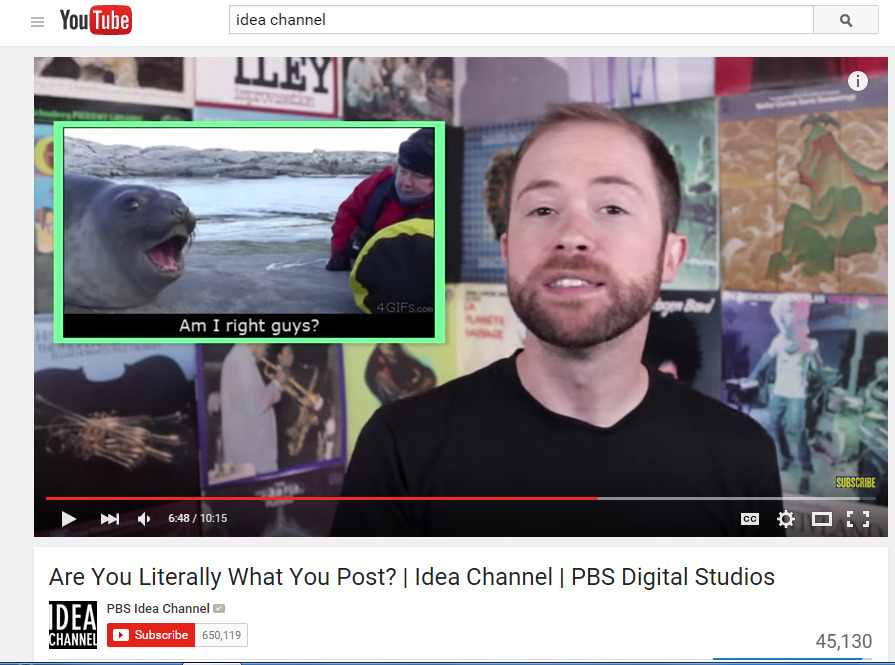
Or are they? Have we changed the means by which we look at animals, and as a consequence think about them, but not in a fundamental way? Idea Channel has a recent video up which prompted these musings, on self-identity and posting. Around six minutes in this image happened:
and I was struck by how often we see images like that seal. We use animal stand-ins for the self constantly. Of course, in the internet meme era, we use all sorts of other things to stand in for the self - such as cartoon drawings. But in light of Berger I feel the unique relationship humans have towards other animals - all those thousands of years of accumulated history and relations, makes the animal meme something special. Perhaps that’s why they quickly became so popular in the first place.
Thoughts?

Thursday, September 17, 2015

Stress

I don’t manage my stress as well as I should. It’s been one of those “chipaway” issues. I used to be better at it than I was now.

I mean, I used to live in a Zen center at one point.

Meditation, breathing, patience, calm, keeping cool and collected, these were all fine.

At school, today, I had an adrenaline dump, and that sort of scared me. I’ve been angry a lot lately, and trying to figure out why. The reasons are perhaps for a different post (not too likely as I try not to use the blog as "over-sharing therapy time"). But regardless of the reasons, I should be able to do better about the results. Without dedicating my life to living in a Zen center…

JOSH
I don't know how it started!

KAYTHA
You tasted something bitter in your mouth.
It was the adrenaline. The bitter taste was the adrenaline.

The above is from season two of the West Wing. I watched it the other night, as I’ve been rewatching some of my favorite parts of the show. In the episode, Josh is struggling with his stress, caused by trauma. I am so fortunate that mine is not trauma-induced. But watching the episode is how I knew it was an adrenaline rush at school. I had the bitter taste in my mouth.

So I got some good old-fashioned internet advice. Unlike Josh, on the show, I don’t access to some of the world’s best psychologists. Here’s what the net said:

1)      Try to change the thing that is making you stressed. That is a bit out of control: my life. I’m not really very fulfilled, and, more importantly, feel as though I should be doing more.  (So much for therapy on the blog!) What can I say? I hold myself to an inordinately high standard. When you do that you expect a payoff, even if you know it’s unrelated. It feels deserved. Usually teaching has been fun and entertaining, but that’s not true of my current position. So, since the entertainment is what used to get me to work in the morning combined with a noble sense of duty, and I feel my job is neither noble, nor entertaining, that’s unfortunate.

Classes have been going on for five or six weeks now, and the initial rush dying. A bunch of my coworkers are noticeably more piqued than usual. We’re settling in, and the romanticism of the summer’s justifications is wearing off.

2)      Promote better sleeping patterns. If anything, lately, my sleeping patterns have been worse. I’m hitting snooze more, staying up, starting to get bags under my eyes.

3)      Make time to do things you enjoy. Nope! I’ve been cutting them out, actually. Usually I’m okay with this, but, for the past month and a half I’ve been sitting around, bored, unable to afford what I want to do.

4)      Surround yourself with people that make you happy. This rides off of the above. I can’t justify the expense of going out to dinner with friends when I need to be counting pennies. Counting pennies, in general, drives folk mad. The lengthy isolation isn’t helping. I certainly need more local friends. Most of my good friends live on the other side of the United States.

5)      Exercise regularly. I’ve stopped taking walks. I did them for pleasure, then necessity. Then I got a car, and the necessity faded. Vallejo is not a walking community, to say the least.

6,7) Eat healthy and Decrease the amount of caffeine and alcohol you consume. I       am eating a large carb load once a day, with few fresh fruits and vegetables. I had         cut out caffeine, and then reintroduced it. With sugar. And then began to rely on it.       So that’s not good… But, hey, I don’t drink.

8) Help others. I do teach for a living. I think I’m okay on this. It has helped – those       few moments at work that have been fulfilling have been one-on-one helping               students in crisis.

9) Do yoga. You can’t make me.

The other source of my stress, besides my work, is that I’m moving in a couple of weeks. Luckily, this is a good thing for many of these problems. It means I can walk again. Hang out with friends again. Eat better and drink less caffeine. Make time for my enjoyments.

All to the good! But God, it’s stressful. I wanted to be settled by now. And I knew this was coming. But ugh. Each time you move, you have to clean, pack up your life, and I think by the nature of the exercise, reflect on where you are in your life. And, as I mentioned above, I wanted to be further along in life. I expected I’d be doing better by now.

My twenties were admirable. Thanks to certain privations, I managed my finances superbly, and still managed to have fun. I traveled, made friends, and completed milestones. But in the end, I’m staring at less than a year to 30, and I’m single, doing a job I’m not satisfied with (much less thrilled) and just…not there yet.

I wanted to be married at 25, kids by 30.

So now I’m moving down to Berkeley to take at least a year off for my personal life. Hey, with luck, I’ll find someone nice and fall madly in love, all the while as we complement each other’s life goals and values, and then move in together with a healthy dual income to a nice place by ourselves where we can pursue our dreams.


Time for a little me time. Here’s hoping that Berkeley does the trick. I think it will.


Saturday, September 12, 2015

Terza Rima

My favorite canto from Dante's "Purgatorio" (Dillon translation):

And as we climbed higher up the mountain’s lofty
Sides, we passed a threshold, and my mind was darkness.
My dreams were frightening when my guide awoke me.
“What terrors caused your sleep such bold uneasiness?”
I replied, “My visions were of a realm in this
Place, where human souls endure such paramount stress
That man may consider hell’s torments again his
Suffering.” “Your vision is the land we enter.
Where we must wait – for a landlord’s domain this is;
‘Til they decide we are a good and safe renter
And our credit and income are worthy to move,
Here we must suffer.” So ended my presenter.

I've been apartment hunting. I can not wait for it to end.

Monday, September 7, 2015

ISIS

“They’re a bunch of bloody savages. They’re barely even human.”

This is a common film cliché. It is delivered ironically by colonial oppressors, invariably Europeans or Americans. The source of the irony is, of course, that the Europeans are the ones acting like savages against the natives. It’s a common, well-understood trope.

But let’s define, culturally, what it means to be ‘savage’ from this well-known line. The ‘savages’ are looked down on due to their rejection of civilized culture and norms. But more specifically, to be a ‘savage’ you must reject this civilized culture aggressively. Passive rejection of civilization is not deemed ‘savage’: the Khoisan people are not ‘savages’, as they passively resist civilization’s influences. The Apache, on the other hand, by actively fighting back, were deemed ‘savages’ and the ensuing attempts by Americans to destroy their culture made this labeling ironic. But were the Apache civilized? Or is there some distinction between ‘civilized’ and ‘cultured’?

Undoubtedly, we must now define what we mean by ‘civilization’ and ‘civilized’. And this takes me back to intro Anthropology classes. My working definition of ‘civilized’ is ‘a distinct culture which…’ and now it gets hard.

You don’t want to say something like ‘is literate’ because that seems snobbish. There are plenty of long-lasting, successful cultures that have no system of writing. Nor do you want to disclude nomads, so you can’t say anything about that. But you’ve got to draw the line somewhere. The most common definition of ‘civilized’ runs as such: “any complex society characterized by urban development, social stratification, symbolic communication forms, and a perceived separation from, and domination over, the natural environment.”

This brings up the old European concept of the “noble savage”. In the Enlightenment, it was increasingly common to look upon non-civilized peoples as noble, even though they hadn’t figured out how to make trains yet. The sentiment may be in the right place – just because a culture or person isn’t an urban-dwelling, letter-writing type doesn’t mean they aren’t worthy of the nobility and dignity of the human race. But it is rather condescending. So we’ll adopt the standard definition of ‘civilized’ and needs must leave our nomads behind, while acknowledging that this is not a form of commentary, or judgmental decision, but instead a practical one.

Considering the historical Apache, it is clear that they wouldn’t exactly, be ‘civilized’, as they were a nomadic people. So for our definition of ‘savages’ the aggressive party needs to be cultured, and not necessarily ‘civilized’ to resist. And this makes sense. If it was one civilized group against another, it would be unlikely that the epithet ‘savages’ would be used in a genuine sense. But no one may doubt that the Apache were cultured – for culture is merely inherited understandings of a group, whether that is writing, art, laws, customs, or what have you.

So is ISIS civilized? Are they a distinct culture? We’ve established that in order to be savages, they must reject civilized culture aggressively, while possessing cultural traits, but not civilized ones.

I think it is easy to argue that they are a distinct culture. They have a clear set of rules/laws and ideas, and a particularly abhorrent religious fundamentalism due to their promotion of violence. Are they civilized? Here I would argue that, no, they are not civilized. As a nomadic peoples, and as a peoples with no real urban development, they do not qualify – although, clearly, they are trying to become so in a violent ex nihilo sort of way.

But for now, as they attempt to erase history by destroying buildings and archaeological sites, as they attempt to erase history, by burning books and killing those who stand opposed to their doctrine, as they attempt to wipe out any religion but Islam, and more specifically their own cruel variant, as they commit acts of genocide, mass beheadings, torture, rape and slavery, targeting members of the press, and using child soldiers how could we say this is civilized? 

For, in the past century, we have, as a species, begun to create bonds anew wherein we find ourselves sharing a common heritage, a common set of laws, a common adoption and value of human rights, and pride in human dignity. Our cultural lineage is the history of all peoples. To be civilized is more than the anthropological definition, as we collectively enter the 21st century. It is to be inheritor of the vision of a striving for our noblest ideals, for the inherent worthiness of all persons, and the freedom to exercise our talents and genius for the betterment of all humanity.


ISIS isn’t civilized. They’re a bunch of savages. And we can say so, and must say so, without irony, without sarcasm, without cynicism, and with the sincerest judgment.